The way customers discover, evaluate, and purchase products online is undergoing a fundamental transformation. Traditional storefront-driven journeys—where customers browse, search, and check out on a website—are increasingly being augmented, and in some cases replaced, by AI-powered agents that search, compare, and transact on behalf of users.
To support this shift, Google introduced the Universal Commerce Protocol (UCP), a standardized framework that enables commerce platforms to expose product catalogs, pricing, availability, and fulfillment capabilities to intelligent agents in a consistent and scalable way.
Over the past few weeks, teams working closely with Adobe Commerce and Magento Open Source have begun actively evaluating and implementing UCP-compliant APIs—preparing commerce platforms for this next phase of AI-driven interaction.
What Is the Universal Commerce Protocol (UCP)?
The Universal Commerce Protocol (UCP) is an open, standardized API framework designed to enable AI agents, platforms, and marketplaces to interact with commerce systems in a consistent, secure, and scalable way.
Rather than building tightly coupled, platform-specific integrations for every new AI surface, UCP defines a shared contract that external agents can reliably consume.
At a high level, UCP standardizes:
- Common commerce intents
Browse, search, price checks, availability lookup, checkout, and fulfillment - Standard event types
Order placed, payment authorized, shipped, delivered, canceled, returned - Clear API contracts
Well-defined schemas designed for machine consumption - Discovery mechanism
A /.well-known/ucp endpoint that allows agents to understand a merchant’s supported capabilities.
In simple terms :
UCP allows a commerce platform to “speak” a language that AI agents understand—opening the platform to an entirely new mode of discovery and transaction.
Much like Schema.org helps search engines understand content, UCP helps AI shopping agents understand how to transact.
What Is Agent Commerce?
Agent Commerce represents a shift from user-driven navigation to agent-driven execution.
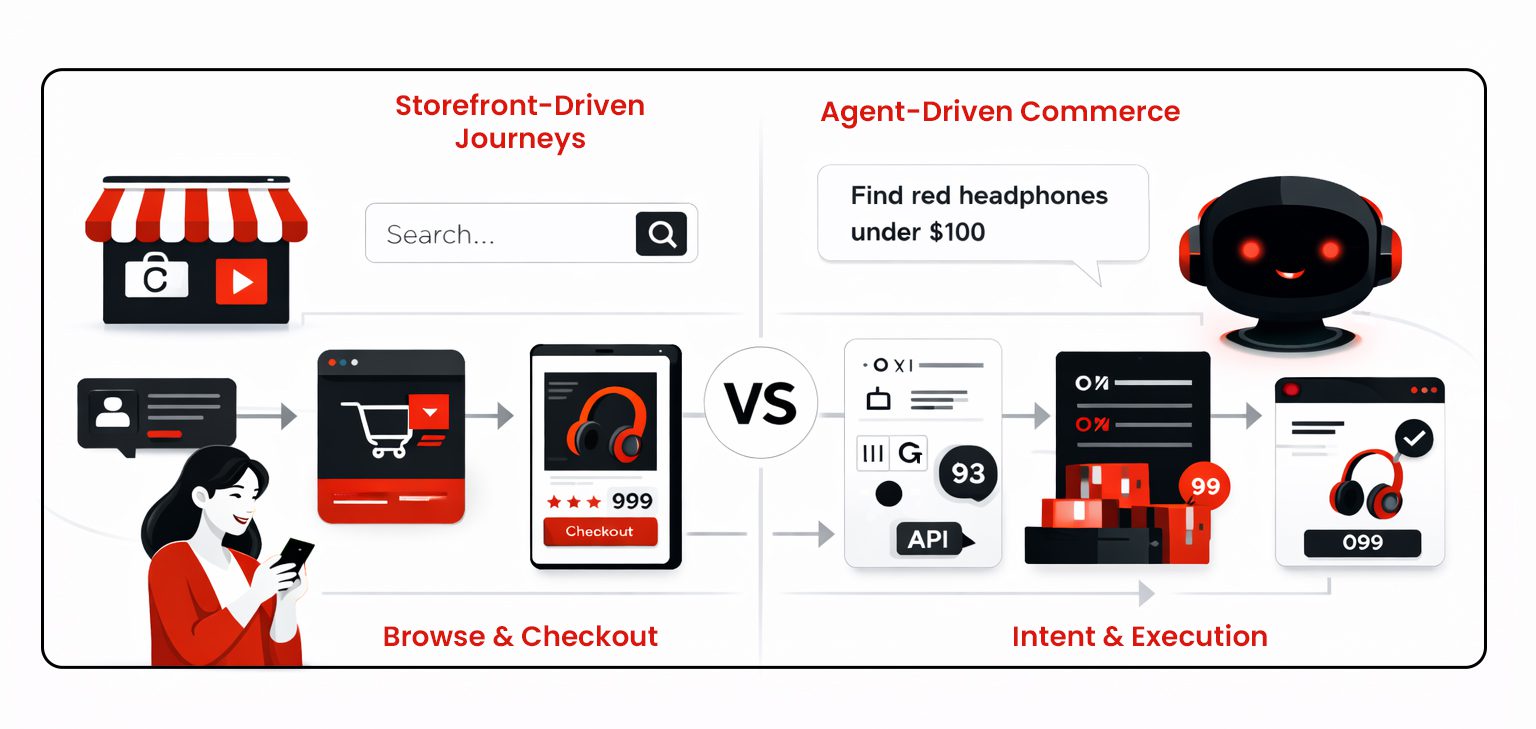
In this model:
- AI agents—powered by platforms such as Google Gemini, OpenAI, or enterprise procurement systems.
- Act on behalf of users to discover products, compare options, validate constraints, and place orders.
- Without users manually browsing a traditional ecommerce storefront.
Real-world examples
- Consumer shopping “Find me a lightweight carry-on suitcase under $300 with free shipping.” An AI agent queries multiple UCP-enabled stores, compares options, and completes the purchase.
- B2B procurement An enterprise agent automatically reorders inventory when stock drops below a threshold, checking real-time pricing and availability across approved vendors.
- Personal shopping & price monitoring Agents learn preferences, monitor prices, and execute purchases when target conditions are met.
For Agent Commerce to work at scale, agents need structured, reliable, and secure access to commerce systems. That is precisely what UCP provides.
To learn more, visit our blog: AI Agents and How They’re Redefining Digital Commerce
Why UCP Matters for Adobe Commerce & Magento Merchants
Adobe Commerce is already a powerful, flexible, and API-rich platform. UCP does not replace it—it extends its reach beyond the traditional storefront.
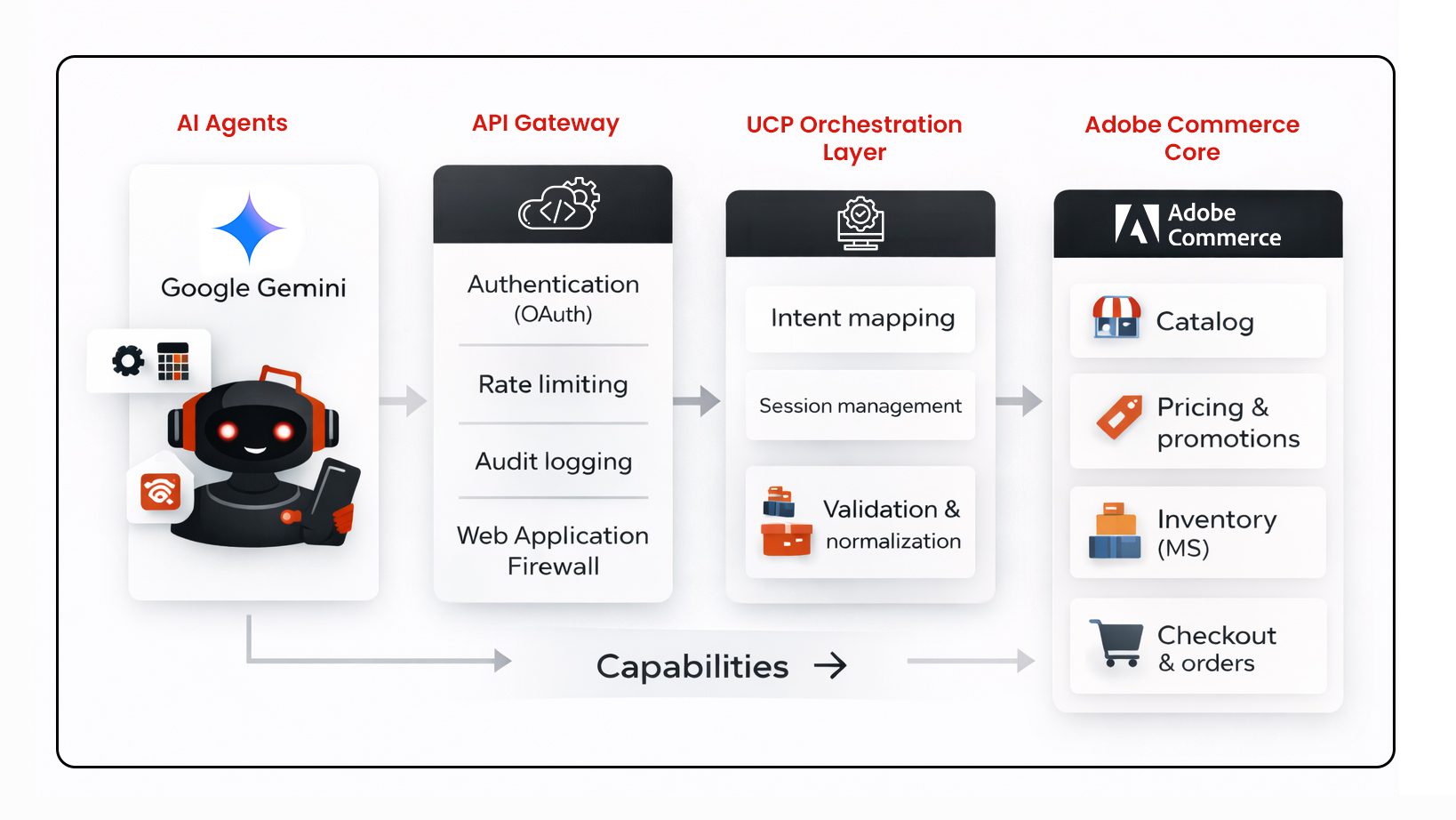
By enabling UCP, Adobe Commerce platforms gain:
- Discoverability
Product catalogs become accessible to AI agents and agentic platforms. - Real-time queryability
Pricing and availability can be evaluated programmatically. - Programmable commerce
Orders can be placed and tracked via standardized APIs. - Agent readiness
The platform becomes a first-class participant in the emerging AI commerce ecosystem.
Who benefits most?
- B2B merchants” Automated procurement, real-time pricing queries, and programmatic reordering.
- Multi-store / multi-country merchants: A unified protocol across storefronts simplifies agent integrations.
- Complex pricing and inventory models: Tiered pricing, MOQs, and regional availability can be exposed deterministically.
- Digitally mature brands: Future-proofing the commerce stack for the next decade of innovation.
Why Merchants Should Prepare Now (Not Later)
UCP and Agent Commerce are still early—but that is precisely why now is the right time to act.
1. Early architectural advantage
Early preparation allows teams to:
- Be discoverable to agents sooner.
- Shape platform architecture proactively.
- Avoid rushed retrofitting as adoption accelerates.
- Build internal expertise ahead of competitors.
2. Minimal disruption today
UCP adoption can be incremental:
- It runs parallel to existing storefronts.
- No changes to customer-facing UX are required initially.
- Teams can start with read-only APIs before enabling transactions.
3. Long-term resilience
As AI-driven discovery becomes mainstream:
- Platforms without agent-ready APIs risk losing visibility.
- Platforms with UCP become easier to integrate into new AI surfaces.
- Early groundwork enables smoother evolution as the protocol matures.
- Merchants that prepare early will be the ones agents can confidently recommend.
How UCP Impacts Discoverability and Conversion
Although UCP is a technical protocol, its business impact is tangible.
Increased discoverability
Products are no longer limited to:
- Traditional search engines
- Marketplaces
- Paid acquisition channels
With UCP, products surface through:
- AI shopping assistants
- Conversational commerce interfaces.
- Enterprise procurement agents.
- Voice-driven and emerging surfaces.
Faster buying decisions
AI agents can:
- Compare pricing instantly.
- Validate availability and fulfillment.
- Reduce friction in decision-making.
- Complete transactions in seconds.
The result is shorter sales cycles and higher conversion efficiency—especially in B2B scenarios.
Key Technical Observations from UCP Implementation
Hands-on implementation highlights several architectural realities:
- Adobe Commerce aligns well with UCP
Its API-first design (REST and GraphQL) provides a strong foundation. Most UCP capabilities can be implemented as orchestration layers on top of existing APIs. - Configuration over core rewrites
Adoption typically involves mapping, normalization, and orchestration—not invasive platform changes. - Security must be designed upfront
UCP endpoints are discoverable. Authentication, authorization, rate limiting, and auditability are non-negotiable. - Session management is critical
UCP checkout flows are stateful. Production systems require durable session persistence (Redis or database-backed), not in-memory storage.
A Typical UCP Checkout Flow
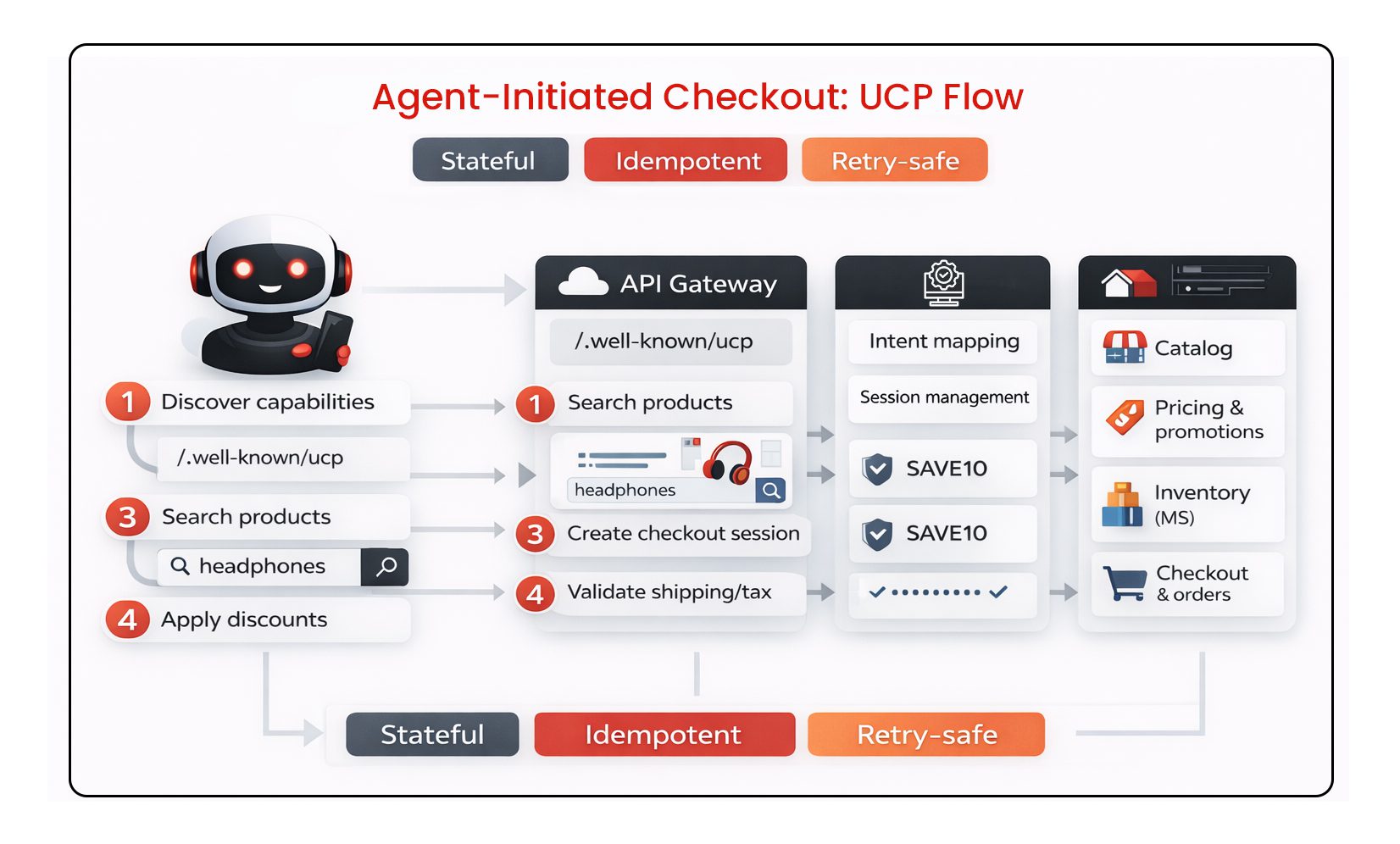
- Agent discovers supported capabilities
- Agent searches products
- Agent creates a checkout session
- Discounts or promotions are applied
- Agent completes payment
- Order is created in Adobe Commerce
Each step must be retry-safe and deterministic.
Is UCP Right for Every Merchant?
Not necessarily—at least not immediately.
UCP makes the most sense today for merchants:
- Planning for long-term scalability.
- Operating in competitive or B2B-heavy markets.
- Already leveraging APIs for integrations.
- Selling across multiple regions or storefronts.
Smaller, single-channel merchants may choose to plan UCP adoption as part of a future roadmap rather than immediate implementation.
What’s Coming Next in UCP
The protocol continues to evolve, with upcoming capabilities such as:
- Multi-item cart support
- Account linking and loyalty integration
- Post-purchase workflows (returns, cancellations)
- Expansion into new verticals like travel and services
Merchants that establish foundational readiness early will be best positioned to adopt these enhancements smoothly.
Final Thoughts
UCP represents a shift in how commerce platforms are consumed—from storefront-driven journeys to agent-driven execution. Adobe Commerce provides a strong foundation for this transition. Success depends less on protocol support and more on architectural discipline, security, and incremental adoption.
Agent readiness is not a feature toggle.
It is a platform maturity milestone.
If you’re exploring how UCP fits into your Adobe Commerce architecture, start with readiness and exposure—not full-scale enablement.