AI for Ecommerce: Examples, Benefits, Solutions, and a Pilot-to-Scale Roadmap
AI for ecommerce is no longer experimental.
It is becoming infrastructure.
Retailers that treat AI as an isolated plugin — a chatbot here, a recommendation widget there — are discovering an uncomfortable truth: disconnected AI creates disconnected results.
The real transformation happens when AI becomes embedded into the commerce engine itself — influencing discovery, pricing, merchandising, supply chain, and lifecycle strategy.
This guide explains:
- What AI for ecommerce really means
- Real-world AI in ecommerce examples
- The measurable benefits of AI in ecommerce
- AI solutions for ecommerce (build vs buy)
- And a structured roadmap to scale from pilot to enterprise adoption
What AI for Ecommerce Means (And What It Is Not)
AI for ecommerce refers to the use of machine learning, predictive analytics, natural language processing, and generative AI to automate, optimize, and enhance commerce operations across the customer lifecycle.
It includes:
- Intelligent search and discovery
- Dynamic personalization
- Predictive demand forecasting
- AI-driven pricing optimization
- Automated content enrichment
- Fraud detection and risk modeling
What it is not:
- A one-time chatbot deployment
- A generative content plugin with no data governance
- A standalone marketing experiment
True AI in ecommerce is systemic, not decorative.
AI in Ecommerce Examples by Business Function
To understand AI for ecommerce strategically, it helps to break down applications by function.
1. Discovery & Search
AI in ecommerce examples:
- Semantic search that understands intent
- Visual search
- Query rewriting
- Dynamic product ranking
Impact:
Improves search-to-product click rate and reduces time to discovery.
2. Conversion Optimization
AI in ecommerce examples:
- PDP personalization based on behavior
- Review summarization
- Dynamic bundling
- Contextual upsell recommendations
Impact:
Increases conversion rate and average order value (AOV).
3. Merchandising & Pricing
AI in ecommerce examples:
- Demand-based pricing
- Margin-aware ranking
- Assortment optimization
- Promotion effectiveness prediction
Impact:
Improves gross margin and sell-through rate.
4. Operations & Supply Chain
AI in ecommerce examples:
- Predictive replenishment
- Inventory risk modeling
- Seasonal demand forecasting
- Warehouse optimization
Impact:
Reduces stockouts and working capital pressure.
5. Content & Catalog Management
AI in ecommerce examples:
- Automated product tagging
- Attribute enrichment
- AI-generated product descriptions (governed)
- Image classification
Impact:
Reduces cost per SKU and accelerates time to publish.
6. Risk & Fraud Management
AI in ecommerce examples:
- Transaction anomaly detection
- Refund abuse detection
- Bot filtering
Impact:
Reduces fraud losses and protects margins.
Benefits of AI in Ecommerce (With Measurable Outcomes)
The benefits of AI in ecommerce are not theoretical. They are measurable when implemented with discipline.
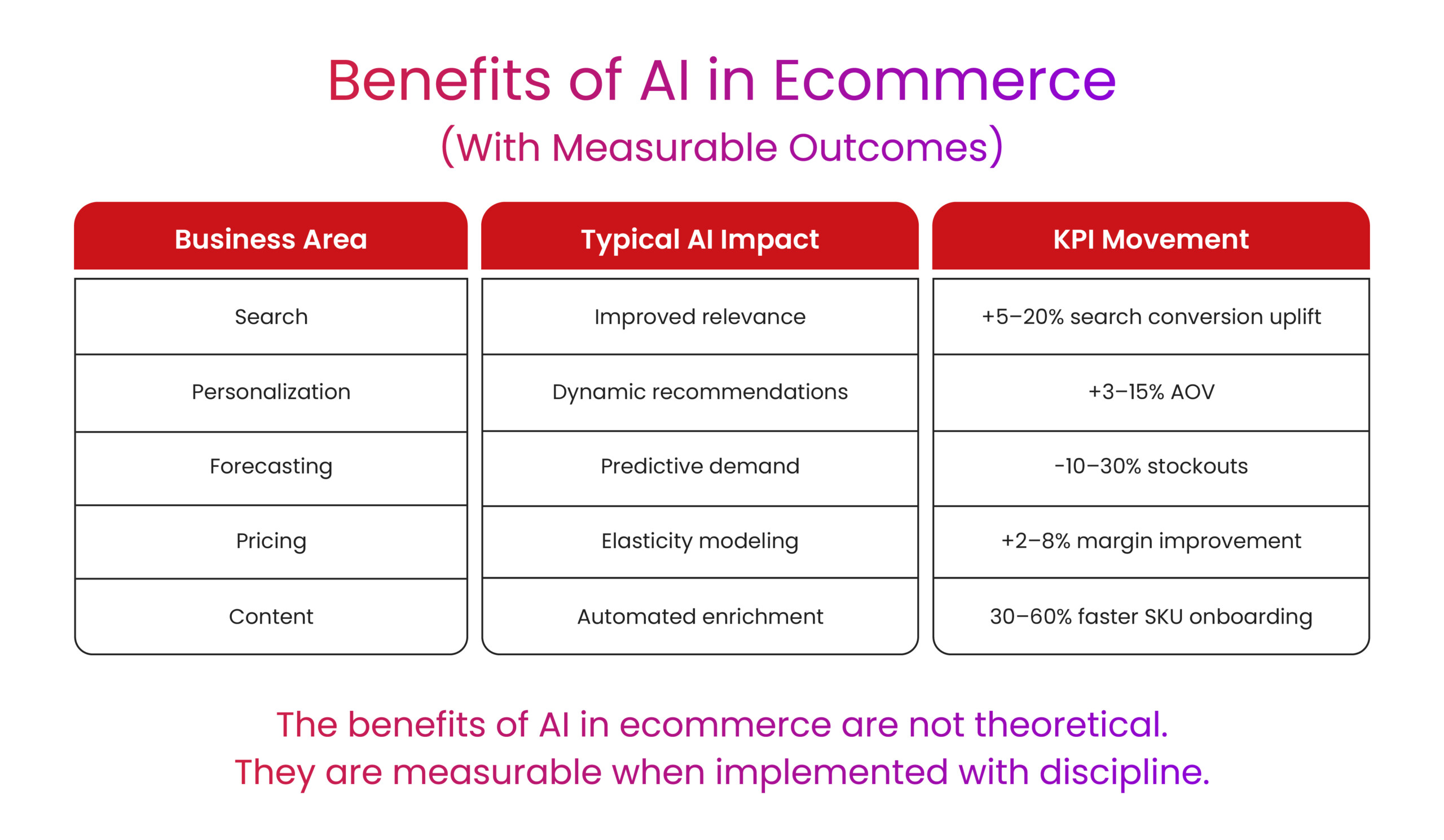
The benefits of AI in ecommerce compound when multiple AI systems operate cohesively.
Isolated AI improves metrics.
Integrated AI transforms performance.
AI Solutions for Ecommerce: Build vs Buy Decision Guide
One of the most strategic decisions in AI for ecommerce is whether to build in-house or buy external solutions.
When to Build
- Strong internal data science team
- Proprietary data advantage
- Custom workflows not supported by vendors
- Long-term cost efficiency objective
When to Buy
- Need faster time-to-market
- Lack of ML engineering resources
- Standardized use cases (search, recommendations)
- Lower initial capital allocation
Integration Patterns for AI Solutions for Ecommerce
AI solutions for ecommerce must integrate across:
- CMS
- PIM
- CDP
- ERP
- Order management systems
- Analytics stack
Common integration architectures include:
- API-first AI overlays
- Embedded AI within commerce platforms
- Data lakehouse-driven AI orchestration
- Hybrid vendor + custom modeling
The wrong integration approach often causes scaling failure, not the AI model itself.
Pilot-to-Scale AI Roadmap for Ecommerce
Scaling AI for ecommerce requires discipline.
Here is a structured roadmap.
Phase 1: Outcome Alignment (0–2 Months)
- Define business objectives (Revenue, Margin, Inventory, LTV)
- Conduct data maturity audit
- Select 1–2 high-impact pilot use cases
- Establish baseline metrics
Phase 2: Targeted Pilot (2–4 Months)
- Launch controlled AI pilot
- Set budget ceiling
- Run A/B testing framework
- Validate measurable uplift
Goal: Prove ROI.
Phase 3: Controlled Expansion (4–8 Months)
- Expand validated use case
- Strengthen data pipelines
- Evaluate infrastructure scalability
- Formalize AI governance model
Phase 4: Enterprise Integration (8–12+ Months)
- Embed AI into merchandising workflows
- Align forecasting with supply chain systems
- Implement monitoring + retraining cadence
- Establish executive-level performance reporting
AI transitions from experiment to operational capability.
Measurement: KPIs, Experimentation, and A/B Testing Templates
AI for ecommerce must be measurable.
Every initiative should define:
- Control vs test group
- Revenue attribution model
- Cost impact calculation
- Latency threshold
- Model precision target
Example KPI alignment:
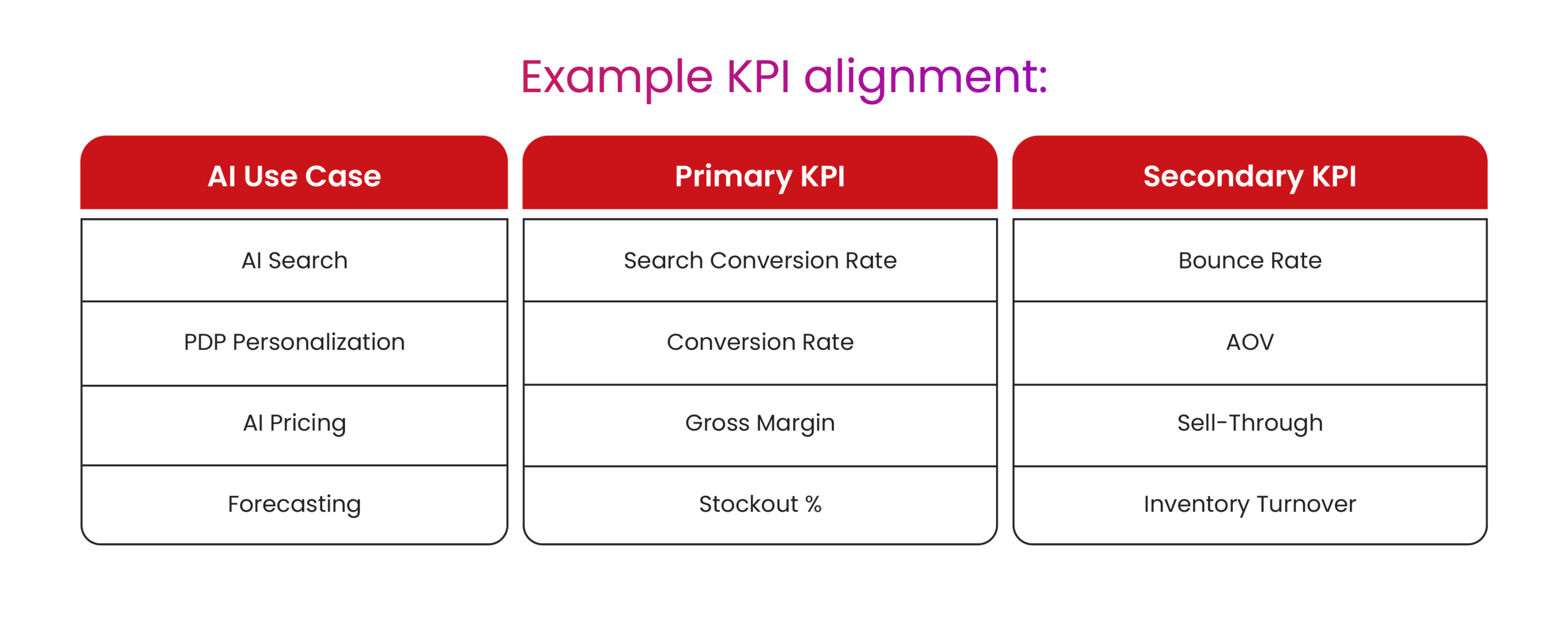
If AI performance cannot be explained in financial terms, it will not survive budget cycles.
Risks of AI in Ecommerce and How to Mitigate Them
AI adoption introduces operational risks.
- Data Risk
Poor data leads to poor predictions.
Mitigation: Strong data governance and validation layers.
- Bias in Personalization
Recommendation bias can distort merchandising strategy.
Mitigation: Regular model audits.
- Hallucinations in Generative AI
Ungoverned AI content may introduce inaccuracies.
Mitigation: Human-in-the-loop approval systems.
- Privacy & Compliance Risk
Personalization must align with consent policies.
Mitigation: Integrated consent management platforms.
- Model Drift
AI performance degrades over time.
Mitigation: Continuous monitoring + retraining cycles.
Responsible AI is strategic risk management, not compliance paperwork.
How do you build an AI roadmap for ecommerce?
To build an AI roadmap for ecommerce:
- Align on measurable business outcomes
- Select high-impact pilot use cases
- Validate ROI through A/B testing
- Strengthen data foundations
- Scale AI through governed enterprise integration