
What Is AI in Data Management?
AI in data management is the use of artificial intelligence, machine learning, and related technologies to automate and improve data management processes such as data cleansing, classification, integration, governance, discovery, and analysis.
Traditional data management often depends on manual processes and predefined rules. AI-powered data management can identify patterns, detect anomalies, automate repetitive tasks, and continuously improve processes as data changes.
Key capabilities include:
- Automated data cleansing
- Data quality monitoring
- Anomaly and duplicate detection
- Data classification
- Metadata generation
- Data discovery
- Data integration
- Predictive analytics
- AI-powered data governance
- Natural-language data access
Why Is AI Important for Data Management?
As enterprise data continues to grow across applications, cloud platforms, databases, documents, and digital commerce systems, manual data management becomes increasingly difficult to scale. AI for data management helps organizations automate repetitive processes, identify data quality issues, improve governance, and turn large volumes of data into actionable insights.
AI-enabled data management helps businesses move from reactive data maintenance to proactive and intelligent data operations.
Key areas where AI adds value:
- Data quality: Detects duplicates, anomalies, missing values, and inconsistencies.
- Data automation: Reduces manual data preparation and processing.
- Data governance: Automates classification, monitoring, and compliance checks.
- Data integration: Helps connect data across disparate systems.
- Data intelligence: Identifies patterns and generates actionable insights.
Core Benefits of AI in Data Management
- Improved Accuracy: AI algorithms minimize human error by detecting anomalies, correcting inconsistencies, and enriching datasets automatically.
- Greater Efficiency: Machine learning streamlines data ingestion, transformation, and analysis processes, accelerating time-to-insight.
- Enhanced Governance: Automated compliance checks and real-time monitoring help maintain data integrity and regulatory adherence.
- Scalability: AI handles vast, complex datasets effortlessly, enabling real-time decision-making and continuous optimization.
Challenges Addressed by AI
AI-driven solutions address several common hurdles in enterprise data management:
- Fragmented data pipelines and inconsistent architecture
- High effort and cost in data cleaning and preparation
- Difficulty accessing, integrating, and classifying unstructured data
- Manual tagging and cataloging, leading to inefficiencies and errors
- Lag in generating actionable insights
AI Data Management vs Traditional Data Management
Traditional Data Management | AI-Powered Data Management |
Manual data cleansing | Automated data cleansing |
Rule-based validation | AI-driven anomaly detection |
Manual classification | Automated data classification |
Static reporting | Predictive analytics |
Manual metadata tagging | AI-generated metadata |
Reactive monitoring | Continuous data monitoring |
Technical data access | Natural-language data access |
Real-World Applications of AI in Data Management
- AI-Driven Data Cleansing and Profiling
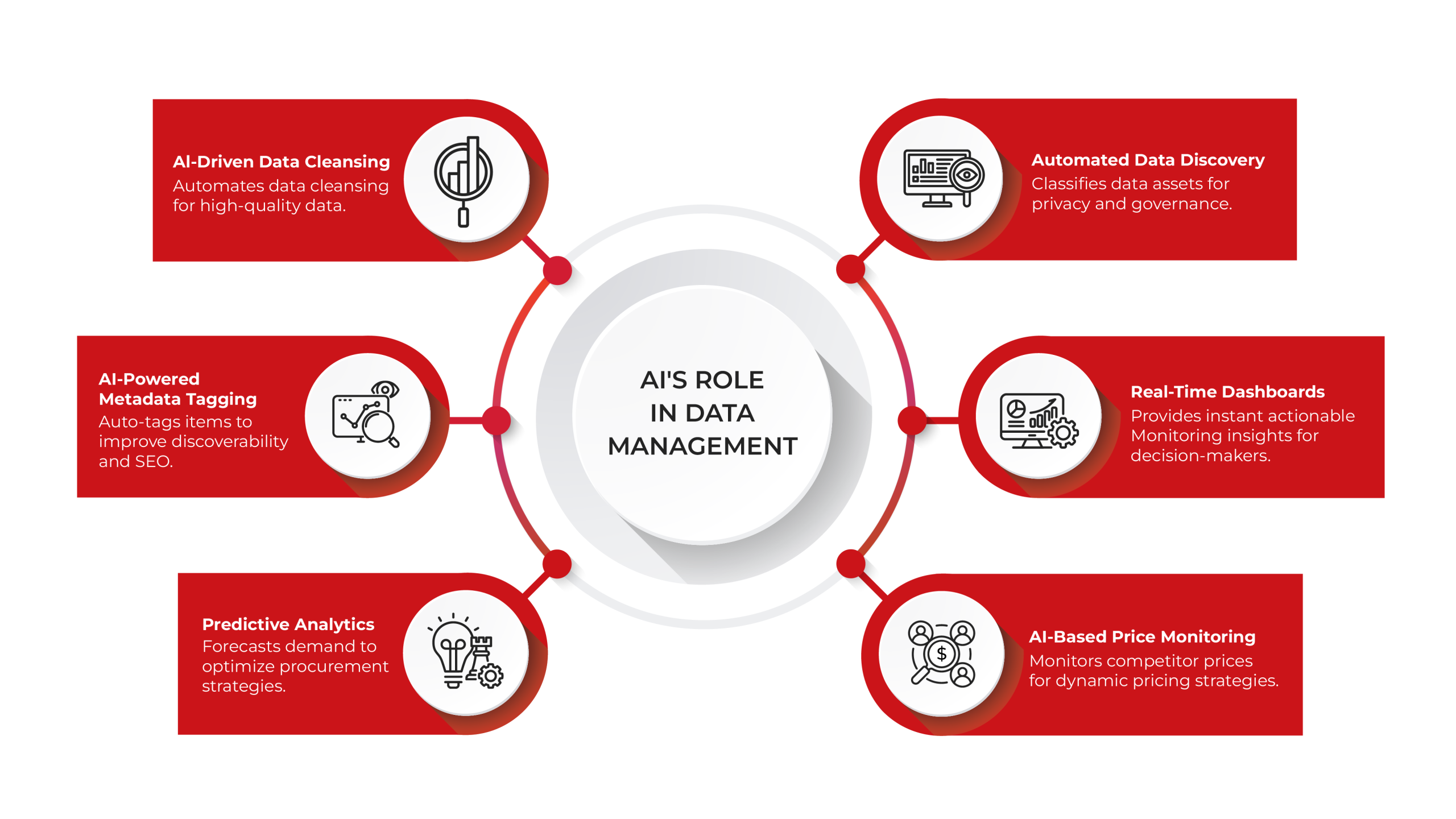
Manual data cleansing is labor-intensive and often inaccurate. AI streamlines this by automating profiling, anomaly detection, and correction. Machine learning algorithms identify data duplication, incomplete fields, and outliers—then resolve them autonomously—ensuring organizations work with clean, high-quality data. - Predictive Analytics for Demand Forecasting
AI helps forecast customer demand, pricing sensitivity, and inventory needs using advanced predictive models. These insights allow retailers to fine-tune procurement and marketing strategies, minimizing waste and maximizing ROI. Our data-driven strategies have helped clients reduce stockouts by 22% and improve planning accuracy. - AI-Powered Metadata Tagging & Catalog Structuring
Product catalogs can contain thousands of items. AI, especially natural language processing (NLP), auto-tags items based on features, descriptions, and historical data. This improves discoverability, enhances SEO performance, and streamlines operations across marketplaces. - Automated Data Discovery & Classification
AI automates the classification of data assets across platforms—identifying sensitive information, labeling structured vs unstructured data, and maintaining classification consistency over time. This is essential for privacy compliance and efficient data governance. - Real-Time Dashboards and Intelligence
AI enhances dashboards with real-time data aggregation, automated anomaly detection, and predictive insights. Decision-makers receive instant, actionable information without waiting on manual reports, driving faster execution. - AI-Based Price Monitoring & Competitive Intelligence
With AI, brands can continuously monitor competitors’ prices, availability, and promotions. Real-time scraping and analysis enable dynamic pricing strategies that respond instantly to market changes. - GenAI for Data Operations
Generative AI assists data teams by summarizing reports, creating synthetic test data, or responding to natural-language queries about performance metrics. It reduces analyst workload and improves accessibility across non-technical teams. - AI-Enabled Compliance & Data Governance
AI tools ensure data security and compliance through automated audits, user access monitoring, and classification of sensitive data. They dynamically adjust policies based on risk and usage patterns, helping businesses meet evolving regulatory standards. - NLP-Based Search and Accessibility
Instead of relying on technical SQL queries or complex dashboards, users can type natural-language questions like “Show revenue by category last quarter.” AI translates these into data queries, improving adoption and speed of access.
Seamless Integration of Disparate Systems
Using low-code/no-code and AI-powered orchestration tools, Iksula helps businesses connect systems like PIM, DAM, CMS, ERP, and CRM. The result is a unified data ecosystem that powers everything from personalization to inventory optimization.
Preparing Your Data for AI Success
AI’s effectiveness depends on the readiness of your data foundation. To ensure success:
- Start with clean, structured, and well-governed data
- Standardize your architecture to enable scalability
- Define clear KPIs and success metrics
- Invest in the right tools and skilled resources
- Pilot use cases before scaling across the organization
Conclusion: The AI-Driven Future of Data Management
AI in data management is helping enterprises move from manual, reactive data operations to intelligent, automated, and scalable data management. By combining AI with strong data quality, governance, integration, and engineering practices, organizations can improve data accuracy, reduce operational effort, accelerate decision-making, and prepare their data foundation for AI initiatives.
The organizations best positioned to scale AI are those that treat data management and AI as connected capabilities, rather than separate technology initiatives.
Contact Us or visit our Insights page to read more.