Forget everything you know about “e-commerce.” The distinction between online and offline is not just blurring—it’s vanishing. We are entering the era of New Commerce, a unified landscape where every touchpoint is a potential point of sale, and every interaction is a data point in a deeply personalized customer journey.
The brands that will thrive in 2026 are not the ones with the biggest ad budgets, but the ones with the most agile, customer-centric strategies. This isn’t another trend list. This is your playbook for the future. Consumer expectations have evolved faster than most retail and D2C brands were prepared for – instant discovery, frictionless checkout, personalized value, and real-time fulfillment are now baseline expectations.
The 2026 commerce landscape won’t be won with incremental tweaks. Brands need a new playbook—one built on AI, data intelligence, and unified commerce execution.
The Core Pillars of the 2026 Playbook
The seismic shifts in retail and D2C can be distilled into three core pillars that will define the winners and losers:
- Pillar 1: Frictionless & Contextual: Commerce that adapts to the customer’s moment, not the other way around.
- Pillar 2: Hyper-Personal & Human-Centric: Using technology to create more genuine, individualized connections.
- Pillar 3: Agile & Resilient: Building business models that can pivot with market and consumer demands.
Let’s break down the key insights that bring these pillars to life.
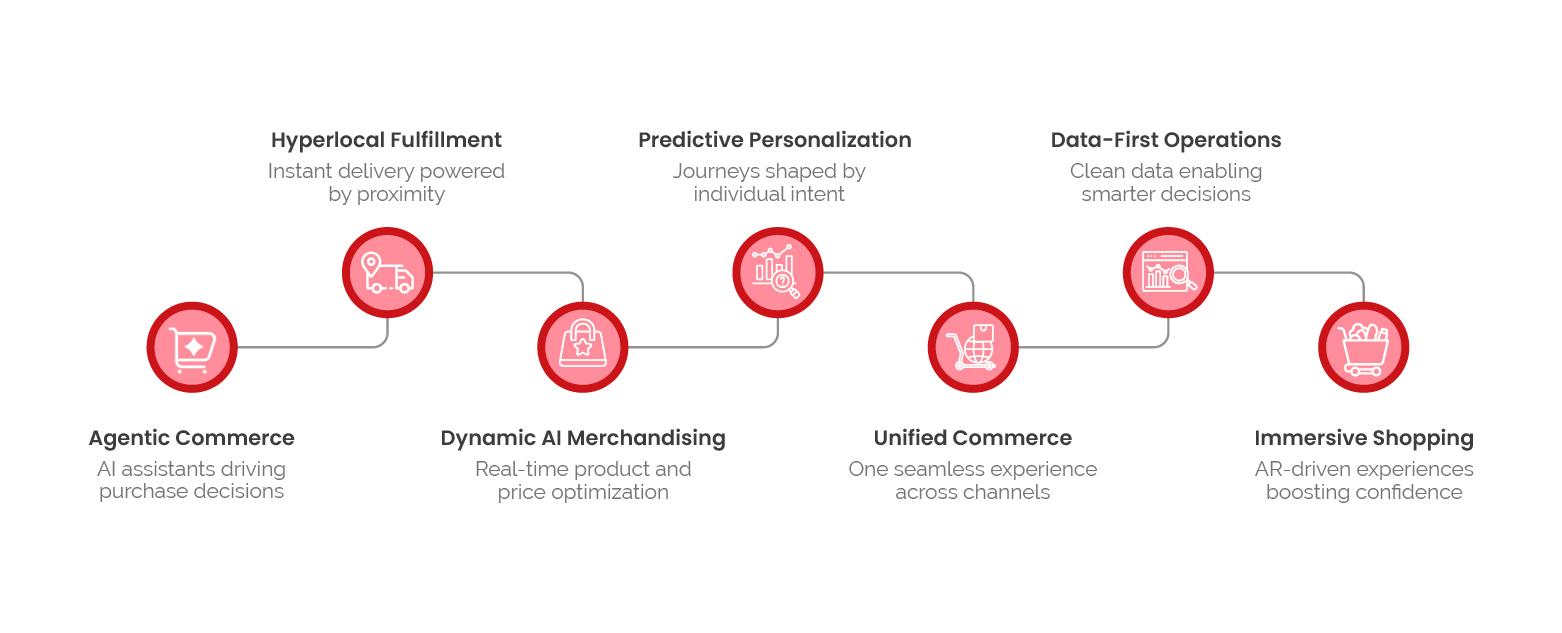
- Agentic Commerce: AI assistants driving purchase decisions
- Hyperlocal Fulfillment: Instant delivery powered by proximity
- Dynamic AI Merchandising: Real-time product and price optimization
- Predictive Personalization: Journeys shaped by individual intent
- Unified Commerce: One seamless experience across channels
- Data-First Operations: Clean data enabling smarter decisions
- Immersive Shopping: AR-driven experiences boosting confidence
Insight #1: The AI-Native Shopping Experience (Beyond the Chatbot)
AI is Your Co-Pilot, Not Just a Tool.
We’ve moved far beyond the simple chatbots of yesterday. In the New Commerce landscape, AI is the intelligent engine powering the entire customer journey. Think of it as a personal shopping concierge that knows your style, your past purchases, and even your real-time context.
Imagine an AI that doesn’t just recommend a raincoat, but one that cross-references your past preferences, the upcoming weather in your location, and items already in your cart to suggest a stylish, waterproof jacket that completes an outfit. This is AI for dynamic bundle creation, hyper-personalized promotions, and predictive support.
The Data Doesn’t Lie: By 2026, we project that brands leveraging AI for deep personalization will see a 25% increase in customer lifetime value compared to those that don’t.
Insight #2: Hyper-Personalization at Scale: The PXM & Content Imperative
Your Product Story is Your Greatest Asset.
Personalization is no longer just about putting a customer’s name in an email. It’s about delivering a unique product experience tailored to the channel, context, and individual. This is where Product Experience Management (PXM) becomes non-negotiable.
In 2026, your product information is no longer a static spreadsheet. It’s a dynamic, adaptable asset. A single product must tell a different story on Amazon than it does on TikTok Shop, a luxury retail partner’s site, or your own D2C store. The imagery, descriptions, videos, and key selling points must be syndicated and optimized for each unique environment—automatically.
Consider this: A running shoe might emphasize “carbon-fiber plate technology” and “elite performance” on a sporting goods marketplace, while the same shoe on a lifestyle site highlights its “sustainable materials” and “city-ready style.”
Insight #3: The Supply Chain as a Competitive Advantage
From Cost Center to Customer Delight Engine.
The race for the customer is won in the last mile. The supply chain has shed its back-office image to become a primary driver of brand loyalty. Consumers now expect a seamless blend of speed, convenience, and sustainability.
This means the rise of hyper-local fulfillment—using micro-fulfillment centers and dark stores to enable 15-minute deliveries in urban hubs. It means transparency is a feature, not a nice-to-have; customers want to know a product’s journey from source to doorstep. Furthermore, AI-powered “demand sensing” is moving supply chains from predictive to prescriptive, drastically reducing waste and stockouts.
Insight #4: The Data Foundation: Your New Commerce Bedrock
Your AI is Only as Smart as Your Data
In the New Commerce landscape, data isn’t just an asset; it’s the very soil in which everything else grows. AI-powered personalization, predictive supply chains, and seamless omnichannel experiences are all compelling branches, but they wither without strong roots. By 2026, data quality and governance will be the single greatest determinant of competitive advantage.
The brands that thrive will be those who have moved from treating data as a byproduct to architecting it as a primary product. This means mastering:
- Impeccable Product Data: Clean, rich, and standardized attributes that power everything from search to syndication across hundreds of partners.
- Unified Customer Identity: A single, accurate view of the customer that stitches together interactions from your website, app, and physical stores.
- Governed Event Streams: Standardized tracking of every customer action, ensuring that analytics and AI models are built on a foundation of truth, not noise.
- First-Party Data Sovereignty: A mature strategy for collecting and leveraging owned customer data, reducing reliance on the volatile cookie-based ecosystem.
- Real-Time Data Pipelines: Systems that feed live, accurate information to AI models, allowing them to make decisions in the moment, not based on last week’s report.
The Stark Reality: Most organizations are drowning in data but starving for insights. Their data is delayed, fragmented across silos, and hopelessly inconsistent. This fundamental breakage is what holds back personalization, cripples automation, and makes experimentation a game of chance.
Insight #5: The Supply Chain as a Competitive Advantage
From Cost Center to Customer Delight Engine.
The race for the customer is won in the last mile. The supply chain has shed its back-office image to become a primary driver of brand loyalty. Consumers now expect a seamless blend of speed, convenience, and sustainability.
This means the rise of hyper-local fulfillment—using micro-fulfillment centers and dark stores to enable 15-minute deliveries in urban hubs. It means transparency is a feature, not a nice-to-have; customers want to know a product’s journey from source to doorstep. Furthermore, AI-powered “demand sensing” is moving supply chains from predictive to prescriptive, drastically reducing waste and stockouts.
The 2026 Action Plan: How to Prepare Today
The scale of this shift can be daunting, but the path forward is clear. Here is your concise checklist to start building tomorrow’s business, today.
- Lay Your Data Foundation: Unify your customer data into a single source of truth. You can’t personalize what you don’t understand.
- Achieve Content Agility: Implement a Product Experience Management (PXM) strategy. Your product content must be an agile asset, not a static file.
- Build Fulfillment Flexibility: Diversify your delivery, pickup, and returns options. Speed and transparency are now key differentiators.
- Invest in an Experience: Pilot one advanced tech feature – be it an AR try-on or a sophisticated AI recommendation engine. Start learning now.
- Foster Your Community: Identify your core advocates and empower them. Build spaces for your customers to connect with you and each other.
Conclusion: The Future is a Seamless Conversation
The New Commerce playbook is built on a simple, profound truth: the customer is at the center of everything. The winning brands of 2026 will be those that stop thinking in terms of “channels” and start designing seamless, valuable, and human conversations across every single touchpoint.
Brands that invest in AI, unified commerce, structured data, experimentation, and operational automation will lead the next decade. Those who cling to old playbooks will fall behind. 2026 belongs to retailers who build intelligently, operate efficiently, and innovate continuously.
The strategies outlined here are no longer futuristic concepts; they are the emerging standards. The question is, will you be following this playbook, or will you be leading the way?
Ready to future-proof your commerce strategy? Talk to an expert today.