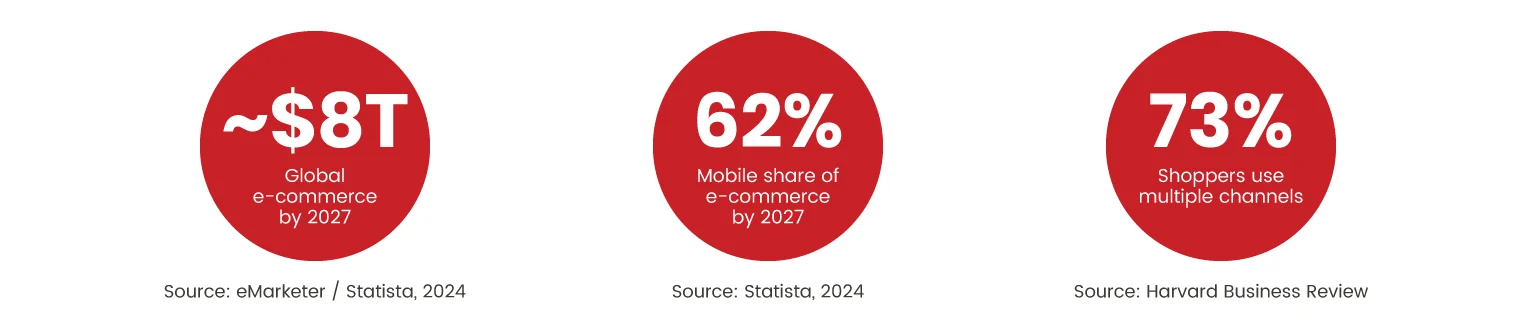
Global retail e-commerce is projected to approach $8 trillion by 2027 — accounting for over 20% of all retail sales worldwide (Source: eMarketer / Statista, 2024). Yet the most pressing challenge isn’t generating traffic or expanding product catalogues — it’s the invisible wall between channels. A shopper might discover a product on Instagram, research it on a mobile app, check availability on the website, and finally buy it in a physical store. In many cases, they may even return it through a different channel altogether.
For retailers, this evolving behavior presents a significant challenge. While customers experience shopping as a single continuous journey, retailers often manage stores, e-commerce, and mobile operations through completely different systems. Inventory may live in one platform, product information in another, customer data somewhere else, and merchandising decisions in yet another tool. The result is fragmented experiences, operational inefficiencies, and missed opportunities to serve customers better.
This is where unified merchandising comes into play. By connecting stores, e-commerce, and mobile channels through a shared data foundation, unified merchandising allows retailers to operate as a single, coordinated ecosystem rather than a collection of disconnected channels.
What Is Unified Merchandising?
Unified merchandising is the practice of managing product assortment, pricing, promotions, and inventory as a single, synchronized operation across every retail channel — physical stores, e-commerce storefronts, marketplaces, and mobile applications.
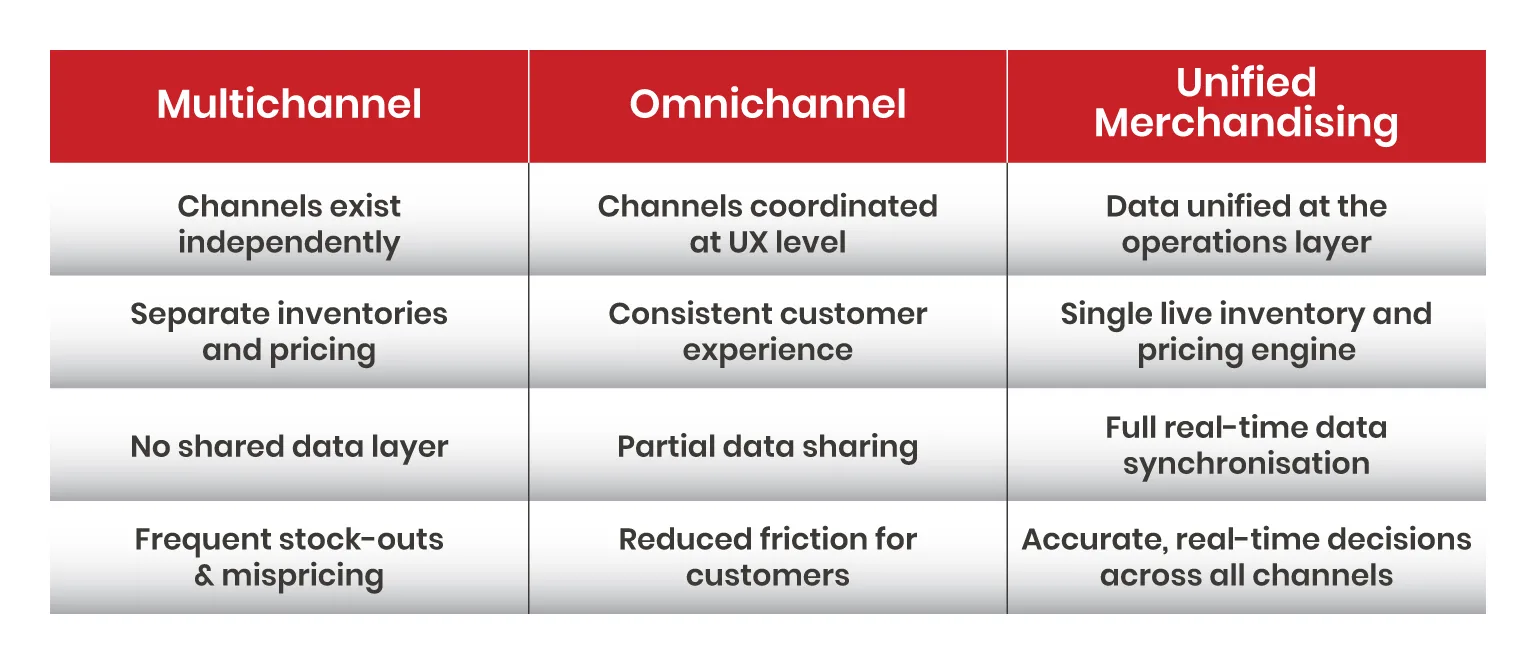
It is distinct from multichannel retail (where channels exist independently) and even from the more familiar concept of omnichannel retail (where channels are coordinated at the customer experience level). Unified merchandising goes deeper: it demands that the data underpinning every merchandising decision — stock levels, pricing rules, product content, promotional eligibility is synchronised in real time and available to every channel simultaneously.
In the context of a full unified commerce strategy — which includes payments, order management, and fulfilment — unified merchandising is the product intelligence layer, ensuring that every channel operates with the same catalogue, pricing, and inventory data.
Related: Omnichannel Experience Solutions — Iksula Explore how Iksula breaks down data silos and delivers consistent product data, pricing, and promotions across every channel. |
At its core, unified merchandising is about managing retail operations through a single, connected view of products, inventory, and customer interactions.
Instead of managing merchandising separately for physical stores, e-commerce platforms, and mobile apps, retailers bring these processes together through a centralized data layer.
This unified approach allows retailers to:
- Maintain a single product catalog across all channels
- Synchronize pricing and promotions in real time
- Track inventory availability across warehouses and stores
- Manage assortment and merchandising strategies centrally
With these capabilities in place, retailers can ensure that the experience customers encounter—whether online, on mobile, or in a physical store—is consistent and accurate.
The Data Backbone: How It All Connects
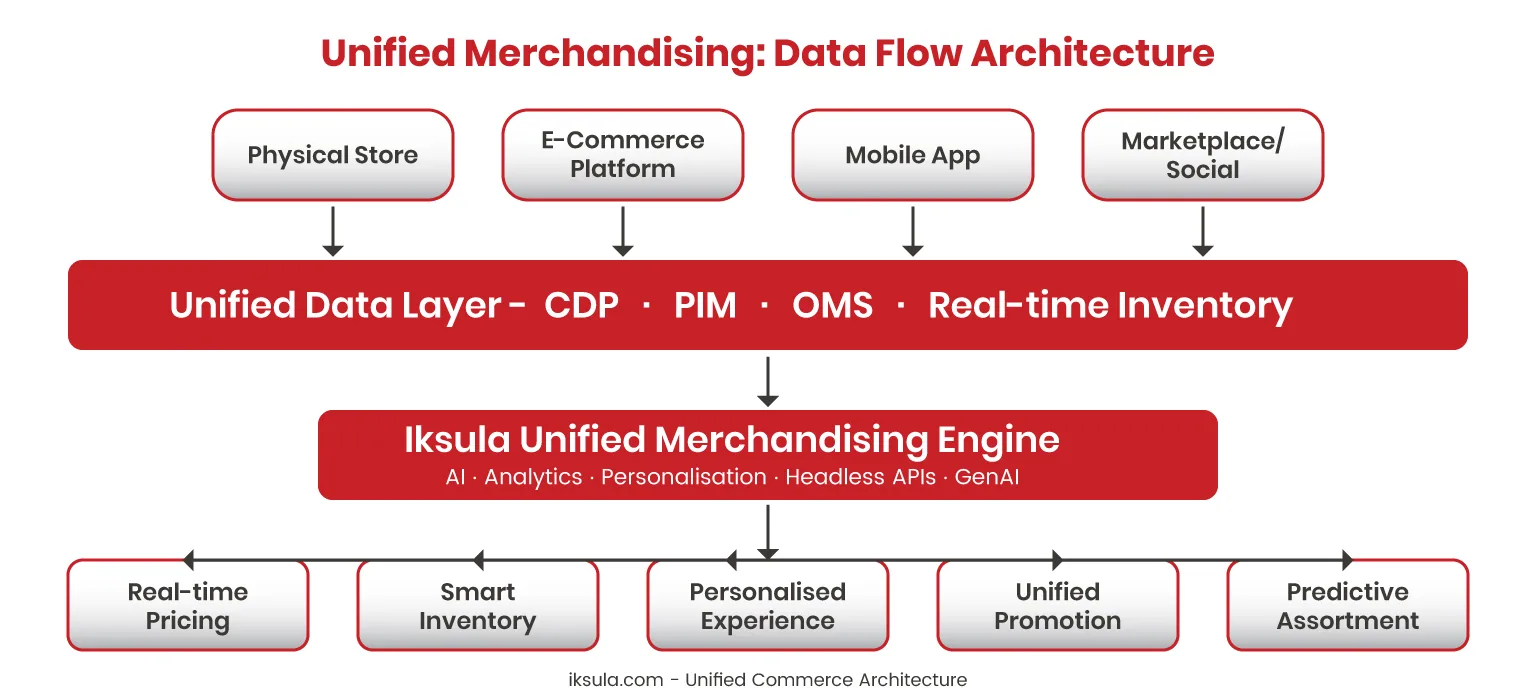
The architecture of unified merchandising rests on a data integration layer that connects three core systems in real time: the POS system in physical stores, the e-commerce platform, and the mobile application. Each generates continuous streams of behavioural and transactional data — and unified merchandising means those streams converge into a single engine that drives every merchandising decision.
The role of the Customer Data Platform (CDP)
A Customer Data Platform sits at the center of a unified merchandising architecture. It aggregates identity and behavioural data from all touchpoints — purchase history, browse patterns, wishlist activity, in-store footfall — and makes a real-time profile available to the merchandising engine. Iksula deploys CDPs on Adobe and Salesforce, merging fragmented customer information into a single unified view that enables tailored engagements for every individual shopper.
PIM and real-time inventory visibility
A Product Information Management (PIM) system ensures product data powering every channel — titles, descriptions, images, attributes, pricing, availability — is consistent and enriched. Combined with a centralised inventory engine, the PIM enables real-time stock visibility across every warehouse, store, and distribution point. Read more: Iksula Omnichannel Stack →
APIs and headless commerce as the connective tissue
Modern unified merchandising architectures are API-first. A headless commerce approach decouples the front-end presentation layer from the back-end commerce logic. This means any channel — a mobile app, an in-store kiosk, a voice assistant — can query the same commerce engine via API and receive a consistent, up-to-date response. Learn about Iksula’s headless commerce services →
Related: Headless Commerce: The Next Frontier in Online Retail — Iksula Blog
How decoupled architecture unlocks channel flexibility and real-time data consistency across every touchpoint.
In-Store and Digital: Closing the Loop
Physical retail is far from dead — but its role has changed fundamentally. Stores are no longer isolated sales venues. They are fulfilment nodes, experience centres, and brand touchpoints that should operate as fully connected components of the broader commerce ecosystem.
BOPIS, BORIS, and endless aisle
Buy Online, Pick Up In Store (BOPIS) and Buy Online, Return In Store (BORIS) are now table-stakes expectations. Both require real-time inventory sync: a customer who orders online for in-store pickup must see accurate stock status, not a promise the store cannot fulfil. Iksula implemented this for a leading HORECA player in Southeast Asia — enabling multi-store delivery setup and consolidated stock visibility across hubs.
In-store data feeding digital decisions
The data flow is not one-directional. In-store behaviour — dwell time near product displays, fitting room utilisation, associate-assisted browsing — generates signals that enrich assortment planning for online channels. See Iksula’s omnichannel retail trends analysis →
Related: Case Study: B2C Launch with Multi-Store Inventory Unification — Iksula How Iksula unified fulfilment and inventory data across multiple hubs for a leading food services company. |
Business Benefits and the ROI Case
Unified merchandising is a significant operational commitment — but the financial case for it is well established. Here is where retailers and brand leaders consistently see the most measurable returns:
- Inventory efficiency: Real-time inventory accuracy prevents costly stock-outs and overstocks, reducing excess inventory carrying costs by 15–20% in mature implementations.
- Catalogue operations: Unified product content management reduces the time and cost of launching products across channels. Iksula has delivered 100% unified data visibility for clients who previously spent days generating cross-channel reports.
- Pricing integrity: Consistent pricing and promotions across every touchpoint eliminate the customer trust damage caused by price discrepancies between channels — a persistent issue in multi-system environments.
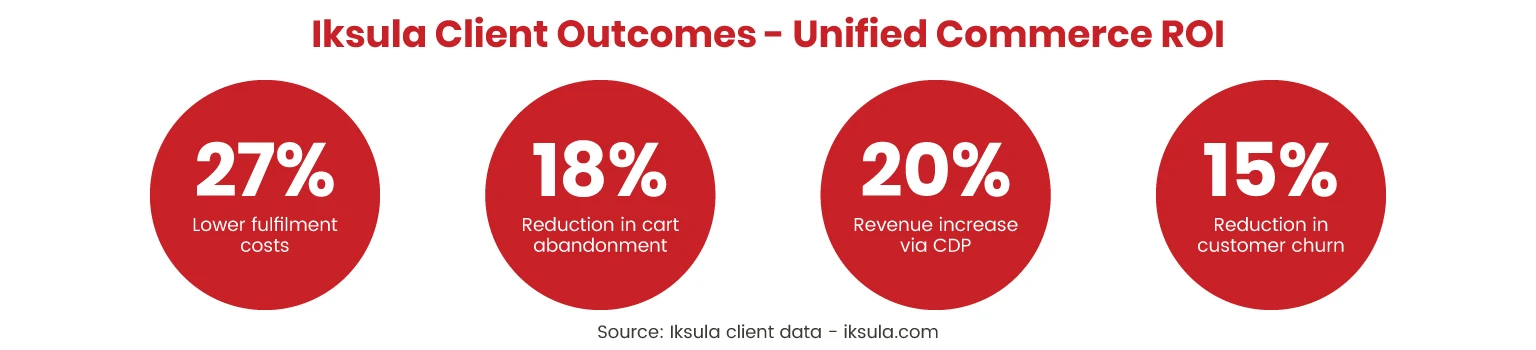
- Customer lifetime value: Personalisation at scale, powered by first-party data from all channels, drives measurably higher conversion rates. Iksula’s CDP integrations have helped clients reduce customer churn by 15% and increase revenue by 20% through targeted recommendations.
- Fulfilment cost: Order management unification enables smarter fulfilment routing — ship from store, BOPIS, next-day delivery — reducing fulfilment cost by up to 27% for unified commerce leaders.
Related: Case Study: Unified Data Foundation with 100% Visibility — Iksula How Iksula integrated CRM, POS, and inventory into a centralised AWS data lake, cutting reporting time from days to minutes. |
Challenges in Implementation — and How to Navigate Them
Unified merchandising is not a single product you install. It is an architecture you build, over a period of time, navigating real technical and organisational complexity.
Legacy system fragmentation
Most established retailers carry a decade or more of system investment: aging ERP platforms, on-premise POS systems, custom-built e-commerce storefronts. The most successful implementations begin with a clear data architecture blueprint and a MACH-based architecture (Microservices, API-first, Cloud-native, Headless) before any vendor is selected.
Data quality and governance
Unified merchandising amplifies whatever data quality exists in your systems. Poor product data — incomplete attributes, duplicated SKUs, inconsistent naming — proliferates when channels are connected. Iksula’s AI-driven data quality engine uses ML-based deduplication, attribute enrichment, and taxonomy standardisation. See also: DAM Solution for FMCG Company in 190 Countries →
Organisational silos mirror technical silos
Channel P&L structures, separate marketing budgets for digital and physical, and siloed merchandising teams are as significant a barrier as any technology gap. Unified merchandising requires shared KPIs — total customer lifetime value, blended fulfilment cost, cross-channel return rates.
Phased rollout reduces risk
The most effective approach is phased implementation: beginning with product and inventory data unification (highest ROI, lowest UX risk), then expanding to promotions and pricing synchronisation, then to personalisation and predictive merchandising.
How Iksula Powers Unified Merchandising
Iksula is a leading global e-commerce solutions provider with over four decades of combined experience, supporting more than a dozen billion-dollar companies in transforming their commerce operations. Unified merchandising is at the core of what Iksula delivers — through a combination of technology engineering, data and AI capabilities, and managed operations.
Unified data foundation
Iksula builds analytics-ready data foundations by integrating CRM, POS, and inventory systems into a centralised data lake — delivering 100% unified data visibility and reducing reporting time from days to minutes. Powered by the Conversational Data Insights (CDI) platform, retail leaders can interrogate their unified data in natural language and get instant answers to merchandising questions.
Merchandising & personalisation solutions
Iksula’s personalisation solutions span the full spectrum: Product Content Services for rich, accurate, channel-ready product data; Pricing Intelligence for real-time competitive pricing; and Assortment Intelligence for data-driven range planning informed by cross-channel demand signals.
Adobe Commerce and omnichannel platforms
As a certified Adobe Commerce partner, Iksula delivers scalable storefronts with integrated analytics, CDP connections, and personalisation engines — combining content, commerce, and analytics into a single ecosystem for smarter, real-time merchandising decisions.
AI and GenAI capabilities
Iksula’s GenAI product content platform accelerates catalogue enrichment at scale. The CDI platform allows retail leaders to interrogate unified data in natural language. Iksula’s AI-driven data quality engine ensures the product data powering every channel is accurate, consistent, and complete.
Headless and MACH commerce
Iksula’s headless commerce services give retailers architectural flexibility to connect any front-end channel — mobile app, in-store kiosk, progressive web app, voice — to a single commerce backend via API. Read: Top Headless Commerce Platforms for 2025 →