What Is AI-Powered Search?
AI-powered search is an intelligent search technology that uses artificial intelligence, semantic understanding, machine learning, and natural-language processing to understand what shoppers mean—not just the keywords they type. In e-commerce, AI-powered search helps customers discover relevant products faster by connecting search intent with product attributes, context, behavior, and business rules.
The revenue cost of bad search
Zero-results pages are revenue sinkholes. When a user searches and gets no results, 68% abandon the session immediately (Baymard Institute). A 2% zero-results rate on a $500M retailer with 40M site visits per year represents approximately $8–12M in avoidable lost revenue annually — a number that a CDO can take to a CFO in 10 minutes.
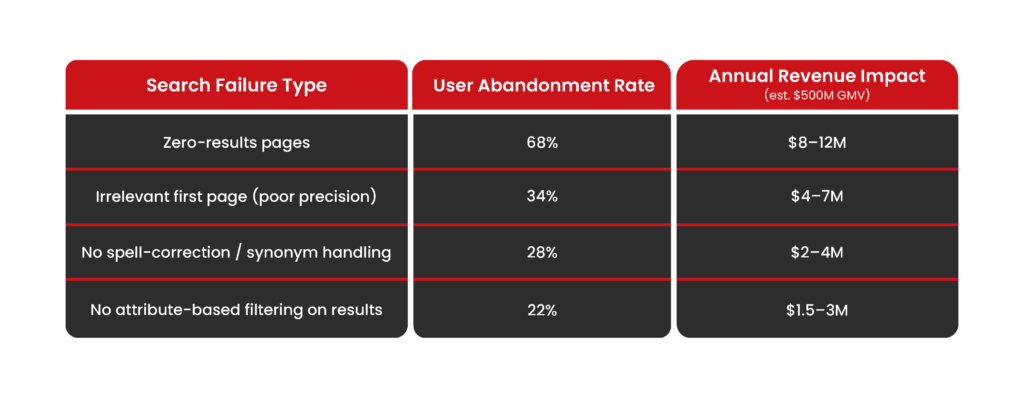
Estimates based on Baymard Institute, Forrester, and Iksula deployment benchmarks. Individual retailer results will vary with traffic volume and average order value.
Why AI-Powered Search Matters for Enterprise Retail
Enterprise retailers manage thousands or millions of products across multiple categories, markets, channels, and customer segments. Traditional keyword search can struggle when shoppers use conversational, incomplete, or intent-based queries.
AI-powered search helps retailers:
- Understand natural-language and conversational queries
- Improve search relevance beyond exact keyword matching
- Reduce zero-result searches
- Connect shoppers with relevant products faster
- Improve product discovery across large catalogs
- Support personalized and contextual search experiences
- Handle synonyms, attributes, spelling variations, and product terminology
- Combine customer intent with product data and business rules
For modern commerce businesses, search is no longer simply a navigation feature. It is an important part of the digital storefront and customer journey.
From Keyword to Intent: How AI Search Actually Works
AI-powered search combines multiple technologies to understand shopper intent and retrieve relevant products. Enterprise e-commerce search commonly combines keyword retrieval, semantic search, machine learning, product attributes, and business rules to improve search relevance.
AI-powered search closes this gap in three layers
Layer 1: Semantic search (dense retrieval)
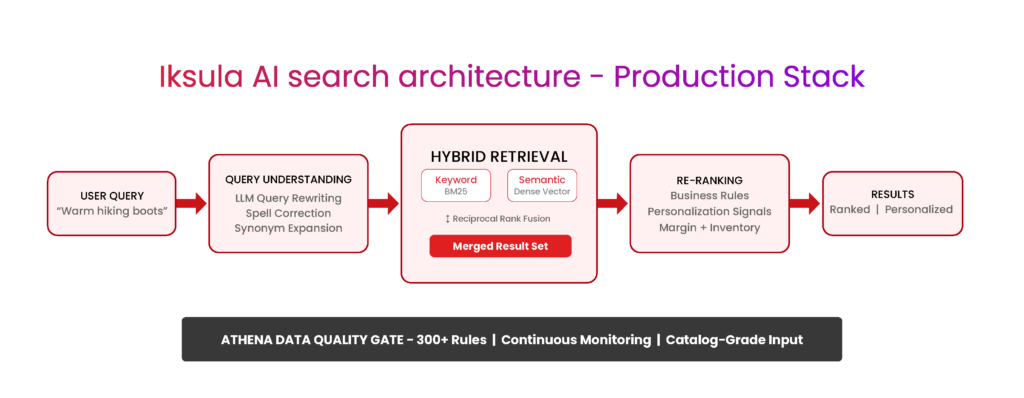
Semantic models (BERT, Sentence-BERT, E5, or domain-fine-tuned variants) convert both queries and product descriptions into dense vector embeddings — multi-dimensional numerical representations of meaning. At query time, the user’s intent vector is matched against product vectors by cosine similarity, surfacing semantically relevant products regardless of keyword overlap.
Layer 2: Hybrid retrieval (keyword + dense)
Pure dense retrieval excels at intent matching but can miss exact product codes, SKU numbers, and branded terms. Hybrid retrieval combines BM25 (keyword precision) and dense vectors (semantic recall) using reciprocal rank fusion — giving the search engine precision on exact matches and recall on intent-based queries simultaneously. This is the architecture Iksula deploys in production.
Layer 3: Query rewriting with LLMs
When a query is ambiguous, malformed, or outside the retailer’s catalog vocabulary, a lightweight LLM rewriting layer expands, clarifies, or translates the query before it hits the index. This reduces zero-results rates by 40–60% in production deployments without changing the underlying index or product data.
Benefits of AI-Powered Search for E-Commerce
AI-powered search can help enterprise retailers improve both customer experience and commerce performance.
Better Product Discovery: Helps shoppers find relevant products using natural-language, semantic, and attribute-based queries.
Higher Search Relevance: Combines keywords, product attributes, semantic relationships, and business rules to deliver more relevant results.
Fewer Zero-Result Searches: AI-powered query understanding, synonyms, and query rewriting can help retailers handle variations in how customers search.
Improved Customer Experience: Reduces the effort required to find products and enables more intuitive shopping journeys.
Higher Conversion Opportunities: Connecting shoppers with relevant products faster can create more opportunities for engagement and purchase.
Scalable Enterprise Search: AI search can support large catalogs, multiple categories, markets, and digital commerce channels.
The Catalog Prerequisite No ISV Will Tell You About
Algolia, Klevu, and Constructor are excellent search engines. They are not catalog enrichment tools. Every AI search ISV requires clean, complete, attribute-rich product data to perform at its advertised benchmarks. What they will not tell you during the sales process is that most enterprise retailers’ catalogs are missing 30–60% of the attributes required to make semantic search accurate.
What “attribute-complete” actually means
For a power-tool retailer, attribute completeness means every SKU has: product type, voltage, battery type, compatible battery brands, weight, dimensions, included accessories, application type (professional vs. DIY), and material compatibility. Without this, a query for “18V compatible drill bits for Milwaukee” returns nothing — or worse, irrelevant results that erode user trust permanently.
Iksula’s catalog-first search approach
Before deploying any AI search ISV, Iksula runs a catalog quality audit (Athena’s 300+ rule engine) to measure attribute coverage, taxonomy depth, and marketplace-native requirements. Gaps are closed via PC² (attribute generation), WordsworthAI (description enrichment), and PictureAI (visual attribute extraction) before the ISV index is populated. The result: an AI search engine that works in production, not just in demos.
In one engagement with a $1B+ hardware retailer across 45,000 SKUs, this catalog-first approach delivered a +30% on-site search success rate within 90 days of deployment — with zero ISV changes, purely through catalog enrichment.
Agentic Shopping: When Search Becomes a Conversation
The next frontier of AI search is not better ranking. It is conversational product discovery — where a customer describes a need in natural language and an AI agent surfaces, narrows, compares, and configures the right product without the customer ever clicking through ten filter facets.
Iksula’s Product Selector Agent (part of the Deep Agent AI platform) handles this for complex B2B and B2C discovery scenarios — guided selling workflows for industrial equipment, configurators for furniture and custom products, and compatibility-aware search for spare parts and accessories. The Universal Commerce Protocol (UCP) makes this agent available across Adobe Commerce, voice interfaces, and API commerce channels.
Key Components of an Enterprise AI Search Solution
An effective AI-powered search solution typically combines:
- Semantic search for understanding meaning and intent
- Keyword search for exact product names, SKUs, and terminology
- Hybrid search for combining semantic and keyword retrieval
- Product taxonomy for structured product categorization
- Product attributes for precise filtering and matching
- Query understanding for interpreting natural-language searches
- AI-powered recommendations for contextual product discovery
- Business rules for merchandising and commercial priorities
- Analytics and monitoring for measuring search performance
The 60-Day AI Search Upgrade Roadmap
Improve the FAQ section
AI-powered search uses artificial intelligence to understand search intent, natural language, product attributes, and context to deliver more relevant results than traditional keyword-based search.
AI-powered search combines technologies such as semantic search, keyword retrieval, machine learning, query understanding, product data, and business rules to connect shoppers with relevant products.
Semantic search uses AI to understand the meaning and intent behind a query rather than matching keywords alone. It helps shoppers discover relevant products even when their search terms do not exactly match product descriptions.
Traditional search primarily matches keywords, while AI search can understand intent, context, natural language, product relationships, and attributes to improve search relevance.
Iksula helps enterprises improve AI-powered search through product data enrichment, catalog governance, taxonomy optimization, semantic search, conversational discovery, and AI-led commerce solutions.
Your Search Is Losing Revenue Every Hour
Book a 30-minute AI search audit with Iksula. We'll baseline your zero-results rate, attribute coverage, and search success rate — and show you the exact enrichment gap between your current catalog and production-ready AI search.
Book AI Readiness Review