Skip to content Skip to footer

Zero-Click Commerce Is Coming. Is Your Catalog Ready?

Zero-Click Commerce Is Coming. Is Your Catalog Ready?

For nearly three decades, the rules of online shopping were simple: invest in SEO, run ads, build a beautiful website, and convert the visitor. Every dollar in ecommerce assumed one thing — the shopper would click.

That assumption is now broken.

Info Box
What changed? In September 2025, OpenAI launched Instant Checkout inside ChatGPT. In January 2026, Google announced the Universal Commerce Protocol (UCP) at NRF, backed by Walmart, Target, Shopify, and Visa. Amazon's 'Buy for Me' has been live since April 2025 — purchasing from third-party sites without the customer ever leaving Amazon.

Welcome to zero-click commerce: a world where AI shopping agents discover, compare, and complete purchases on behalf of customers — without a single click on your website. This is not a future scenario. It is happening right now, in 2026, at scale.

For two decades, ecommerce teams optimized for clicks. In the next decade, they will optimize for recommendations. The brands that win won’t necessarily have the best website — they’ll have the most understandable, trustworthy, and AI-ready product catalog.

2. What Is Zero-Click Commerce?

Zero-click commerce means the customer describes their intent to an AI assistant, and the agent handles discovery, comparison, and checkout — often without the shopper ever visiting a retailer’s website.

The Old Journey vs. The New Journey

Before: Search → Website → Product Page → Cart → Checkout
Now: Intent → AI Agent → Recommendation → Approval → Purchase

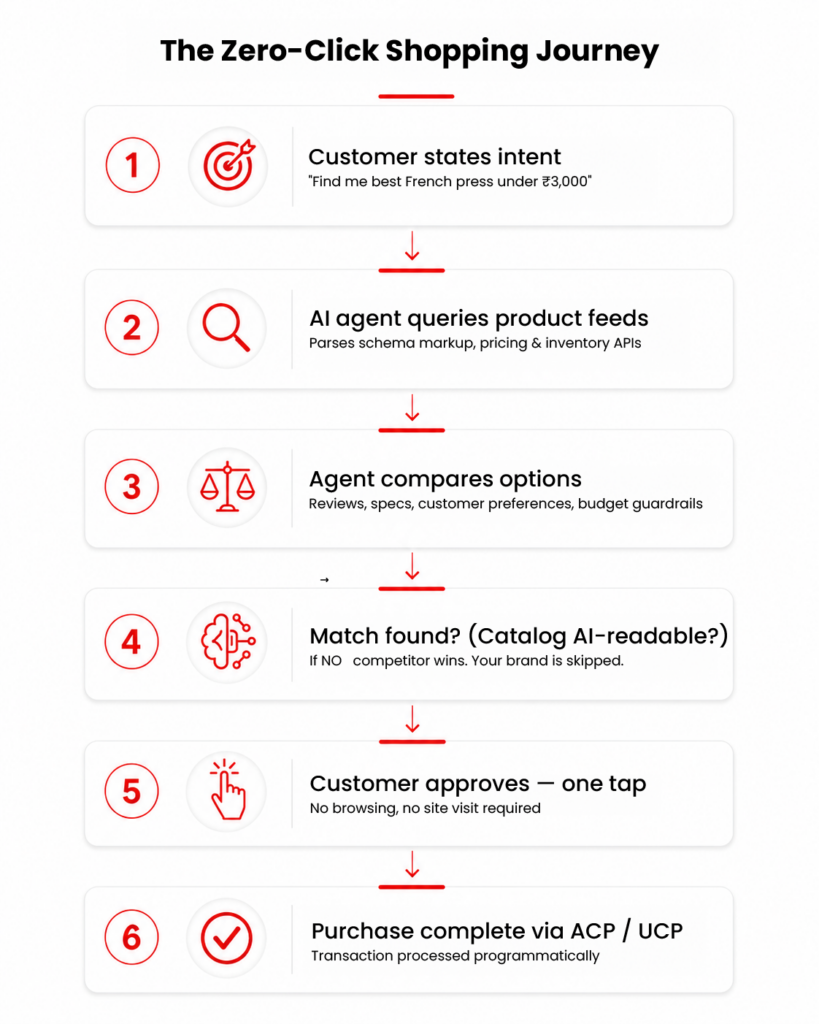
The Zero-Click Shopping Journey
Customer states intent "Find me best French press under ₹3,000"
AI agent queries product feeds Parses schema markup, pricing & inventory APIs
Agent compares options Reviews, specs, customer preferences, budget guardrails
Match found? (Catalog AI-readable?) If NO → competitor wins. Your brand is skipped.
Customer approves — one tap
No browsing, no site visit required
Purchase complete via ACP / UCP Transaction processed programmatically

Fig 1 The AI agent handles every step between intent and purchase. Your brand is either in this flow — or invisible to it.

The Next Evolution: Agentic Commerce

While zero-click commerce focuses on AI-powered discovery, agentic commerce goes further. Autonomous AI agents don’t just recommend products — they actively make purchasing decisions and complete transactions on behalf of consumers:

  • Monitor prices across retailers in real time
  • Compare reviews and specifications without human input
  • Identify promotions and apply coupons automatically
  • Complete checkout and schedule repeat purchases

Example: "Reorder my pet food whenever the price drops below ₹1,800." The AI handles everything. This is AI-executed shopping — not just AI-assisted shopping.


3. Why 2026 Is the Inflection Point

Three forces have converged to make zero-click commerce a present reality rather than a future prediction:

Platform Infrastructure Is Live
  • ACP (Agentic Commerce Protocol) — OpenAI + Stripe, powering ChatGPT Instant Checkout with 900M+ weekly users.
  • UCP (Universal Commerce Protocol) — Google + Shopify + 20 retail partners (Walmart, Target, Visa). Announced NRF 2026.
  • Adobe Commerce — Committed to both ACP and UCP in February 2026.
  • Amazon “Buy for Me” — Agents purchase from third-party sites whether or not the brand agreed to participate.
The Numbers Are Too Large to Ignore

58% of consumers have replaced traditional search with generative AI for product recommendations.

92% — of US B2C marketing executives are already building agentic commerce strategies.

$3–5T — projected global AI-commerce transaction volume by 2030 (McKinsey).

$900B–$1T — projected US retail revenue from agentic commerce by 2030 (McKinsey).

20% — of B2B sellers will face agent-led quote negotiations by end of 2026 (Forrester).

The Zero-Click Shopping Journey
Customer states intent "Find me best French press under ₹3,000"
AI agent queries product feeds Parses schema markup, pricing & inventory APIs
Agent compares options Reviews, specs, customer preferences, budget guardrails
Match found? (Catalog AI-readable?) If NO → competitor wins. Your brand is skipped.
Customer approves — one tap
No browsing, no site visit required
✓ Purchase complete via ACP / UCP Transaction processed programmatically

Fig 1. The AI agent handles every step between intent and purchase. Your brand is either in this flow — or invisible to it.

4. AI Doesn’t See Your Website. It Sees Your Data.

Many retailers spend months perfecting their website design. Hero images, video banners, persuasive copywriting — all built for eyes that browse. AI shopping agents have no eyes. They parse data.

What Humans Use to Shop What AI Agents Use to Shop
Hero images & lifestyle photography JSON-LD Product schema & structured feeds
Persuasive copywriting & brand voice Objective specs: material, dimensions, GTIN
Navigation menus & category pages Real-time inventory & pricing APIs
Reviews browsed on the page Sentiment-analysed review data at scale
Returns policy buried in the footer Structured, machine-readable policy endpoints
Checkout flow with account login ACP/UCP-compatible programmatic checkout APIs
 
Critical insight: If your product catalog lacks proper schema markup, it is effectively invisible to AI shopping assistants — regardless of how much you invest in SEO, ads, or web design. In the world of AI shopping agents, your catalog IS your storefront.
 
📊 FLOWCHART 2 — How AI Agents Evaluate a Product (3-Layer Model)
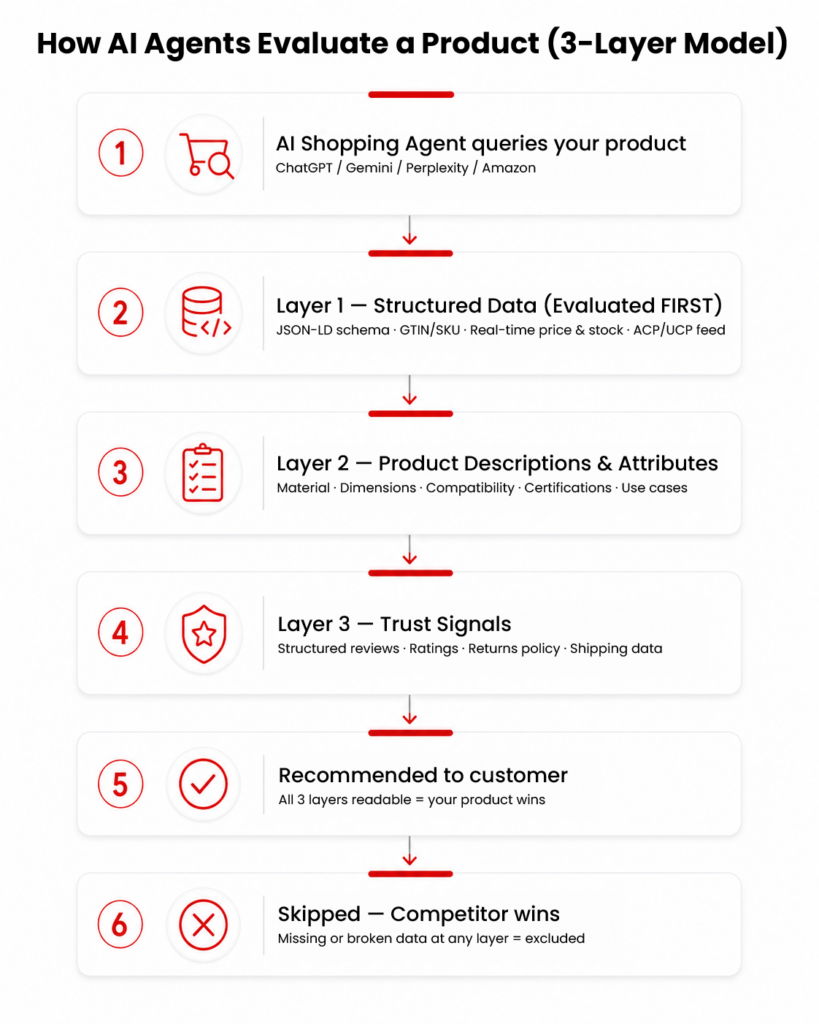
AI Shopping Agent queries your product ChatGPT / Gemini / Perplexity / Amazon
Layer 1 — Structured Data (Evaluated FIRST) JSON-LD schema · GTIN/SKU · Real-time price & stock · ACP/UCP feed
Layer 2 — Product Descriptions & Attributes Material · Dimensions · Compatibility · Certifications · Use cases
Layer 3 — Trust Signals Structured reviews · Ratings · Returns policy · Shipping data
✓ Recommended to customer All 3 layers readable = your product wins
Skipped — Competitor wins Missing or broken data at any layer = excluded

Fig 2. AI agents evaluate structured data first — before reading product descriptions or seeing any brand imagery.


5. What Catalog Ready Actually Means

Catalog readiness for AI is not binary. Think of it as a maturity model — most ecommerce brands in 2026 sit at Level 1 or 2. The goal is Level 4–5 before this channel scales further.

Level Status What You Have
Level 1 Invisible No structured data. AI agents cannot find or evaluate your products.
Level 2 Partial Basic title/price schema. Agents can find you but miss key attributes.
Level 3 Discoverable Complete JSON-LD Product schema. Rich snippets. Accurate real-time data.
Level 4 Agent-Ready ACP/UCP-compliant feeds. Structured reviews. Machine-readable policies.
Level 5 Agent-Optimised Real-time inventory webhooks. Agent-specific product data. Full API checkout.

The AI Catalog Readiness Checklist

Check Why It Matters
Are product titles descriptive and keyword-rich? Helps AI understand the product and match it to user intent.
Are product attributes complete? Enables accurate AI-driven product comparisons.
Are reviews accessible and structured? Builds trust signals agents can parse and weigh.
Is inventory updated in real time? Prevents poor recommendations and agent drop-off.
Is pricing accurate across all channels? Supports reliable AI decisions and checkout.
Is shipping information available? Influences recommendation rankings in agent queries.
Is JSON-LD schema markup implemented? Improves machine readability — the single most important step.
Are product images properly tagged? Supports multimodal AI understanding.

The 5 Core Pillars of AI Catalog Readiness
1. Rich, Objective Product Data

Poor:“Blue T-Shirt”
Better: “Men’s Cotton Crew Neck Blue T-Shirt, Regular Fit, 180 GSM, BIS-certified, Machine Washable”
Replace subjective marketing language with verifiable specifications. “Amazing quality” means nothing to an agent. “304-grade stainless steel, 1.2mm wall thickness, induction compatible” means everything.

2. Complete Product Attributes

AI agents compare products differently than humans — they evaluate structured information: material, dimensions, colour, compatibility, weight, features, warranty, sustainability certifications. Missing attributes can prevent your products from appearing in AI-generated recommendations entirely.

3. JSON-LD Product Schema (Structured Data)

The foundation of AI visibility. At minimum, every product page must include: product name, brand, SKU, GTIN, price and currency, availability, aggregate ratings, reviews, and images — all in machine-readable JSON-LD format.


Critical rule: A product page with accurate price, availability, and SKU is more valuable to AI agents than one with 20 attributes where half are outdated. Accuracy beats completeness.
4. Protocol Compliance: ACP & UCP
  • ACP (Agentic Commerce Protocol): Built by OpenAI + Stripe. Powers ChatGPT Instant Checkout. Shopify merchants can access via native Stripe integration.
  • UCP (Universal Commerce Protocol): Google + Shopify. Enables in-chat purchase through Gemini and Google AI Mode. Non-compliant sites are skipped — even when they rank well in conventional search.
5. Optimised Product Feeds

Review Google Merchant Center feeds, marketplace feeds, product taxonomies, and category structures regularly. Clean, structured, consistent data across all channels will outperform incomplete feeds every time.

6. Traditional SEO vs. AEO & GEO for Ecommerce

Traditional SEO focused on ranking web pages for human searchers. AI introduces two emerging disciplines:

  • AEO (Answer Engine Optimisation): Helping AI systems understand and cite your products when answering user shopping queries.
  • GEO (Generative Engine Optimisation): Improving visibility within AI-generated responses — being selected by AI, not just ranked by Google.

Traditional SEO AEO / GEO for AI Commerce
Rank for keywords in Google SERP Be retrieved by AI agents in shopping queries
Drive traffic to your product page Ensure your product feed is agent-parseable
Measure: CTR, sessions, bounce rate Measure: AI citation rate, agent recommendation rate
Backlinks signal authority Citation age in AI responses signals authority
Top-of-funnel blog content drives discovery Structured product data drives agent discovery
Page speed & UX affect conversion API response latency & reliability affect agent inclusion
"In the GEO world, marketing is data architecture." — Kevin Indig, Growth Memo, January 2026

The most important implication: a detailed, well-written blog post will not improve your ranking in a ChatGPT shopping result. A complete, accurate, real-time product feed will. This is a fundamental resource reallocation for most marketing teams.

7. How to Test If You Are AI-Agent Visible Right Now

Before building anything, assess your current state. These four tests take under 30 minutes:

  1. Google Rich Results Test — Run your top 50 product URLs through search.google.com/test/rich-results. Every failure is revenue at risk.
  2. Ask ChatGPT and Gemini directly — Type: “Recommend the best [your product category] under [your price point].” If your brand doesn’t appear, you are invisible.
  3. Set up AI referral analytics — Create segments to track visits from ChatGPT, Gemini, Perplexity, Copilot. Compare conversion rate vs. traditional search.
  4. Audit attribute completeness — Target 95%+ completion across your catalog. Every missing field is a reason for an agent to prefer a competitor.

8. What This Means for Your Platform

Platform AI Readiness Actions
Shopify Native ACP via Stripe · Google UCP via Merchant Center · Lowest-friction path to agent checkout
WooCommerce Validate schema via Yoast/RankMath · Improve product taxonomy · Manual ACP/UCP integration required
Adobe Commerce Committed to ACP + UCP (Feb 2026) · PIM integration for attributes · Enterprise-grade real-time feed management


9. Your 90-Day Catalog Readiness Roadmap

📊 FLOWCHART 4 — 90-Day AI Readiness Roadmap
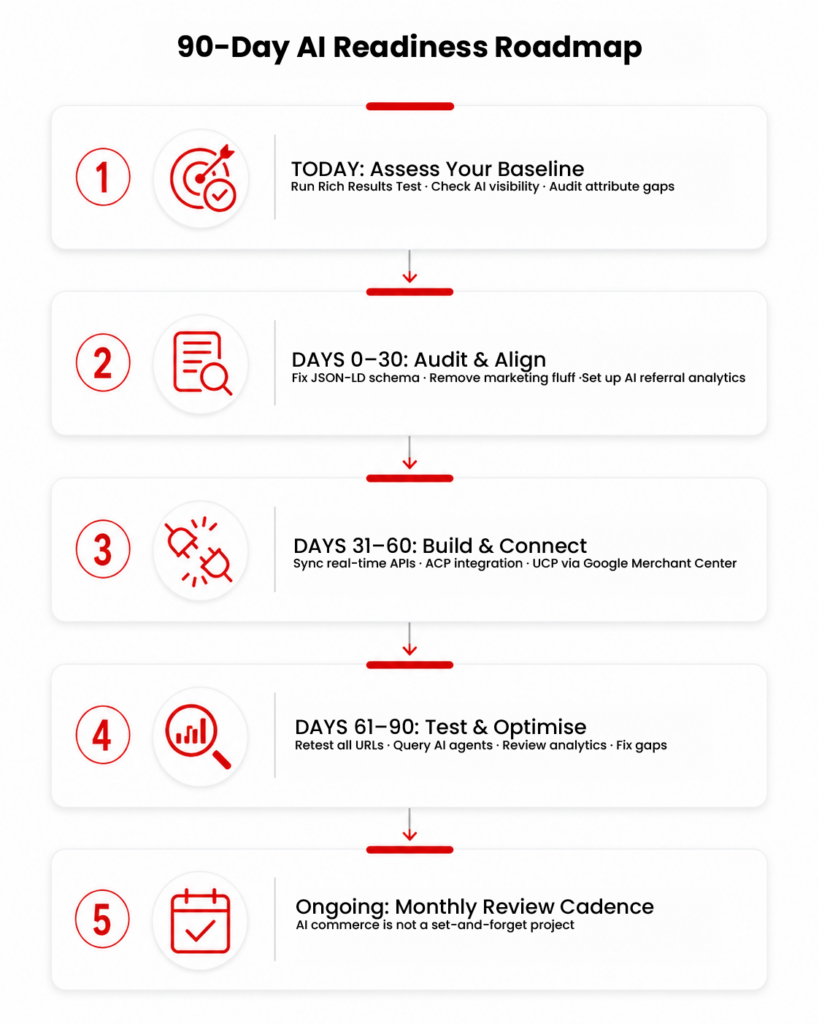
TODAY: Assess Your Baseline Run Rich Results Test · Check AI visibility · Audit attribute gaps
DAYS 0–30: Audit & Align Fix JSON-LD schema · Remove marketing fluff · Set up AI referral analytics
DAYS 31–60: Build & Connect Sync real-time APIs · ACP integration · UCP via Google Merchant Center
DAYS 61–90: Test & Optimise Retest all URLs · Query AI agents · Review analytics · Fix gaps
Ongoing: Monthly Review Cadence AI commerce is not a set-and-forget project

Fig 4. A phased 90-day approach builds foundational readiness before the agent commerce channel scales further.

Days 0–30: Audit & Align
  • Run Rich Results Test on top 50 product URLs
  • Audit attribute completeness across catalog
  • Remove subjective marketing language from descriptions
  • Implement JSON-LD Product schema on all key pages
  • Set up AI referral tracking in analytics
Days 31–60: Build & Connect
  • Map every product attribute to standardised JSON-LD
  • Sync inventory and pricing APIs for real-time accuracy
  • Build structured, machine-readable returns/policies page
  • Begin ACP integration (Shopify + Stripe native path)
  • Start UCP implementation via Google Merchant Center
Days 61–90: Test & Optimise
  • Retest all product URLs with Rich Results Test
  • Query ChatGPT, Gemini, Perplexity for catalog discovery
  • Review AI referral analytics — track agent-surfaced products
  • Identify and fix attribute gaps causing agent drop-off
  • Set monthly review cadence — not a set-and-forget project
10. Will AI Agents Replace Online Shopping?

Not entirely — and that’s an important nuance. People will still browse, discover brands, and engage with content. However, for repeat purchases, functional buying decisions, and comparison-heavy categories, AI agents will increasingly become the primary interface between consumers and brands.

The brands that thrive will be those that make their products easy for both humans and machines to understand. The question is no longer just “Can customers find your products?” — it’s “Can AI find them, understand them, and recommend them?”

The Window Is Open — But It Won’t Stay Open

Every major platform shift in ecommerce had an early-mover advantage window. Early SEO adopters dominated Google for years. Early social commerce brands built audiences when organic reach was free.

Agentic commerce is in that window right now. AI product citations are still being established. A brand that earns consistent citations in AI responses this year — through complete structured data, validated reviews, and protocol compliance — builds a compounding advantage that late movers will find very difficult to close.

Start with one product. Run the Rich Results Test. Fix one gap. That is the beginning of being AI-agent ready.

Author


Let's Get Started! Reach Out to Us