AI Transformation in Retail: From Pilot to Production
AI transformation in retail is the shift from isolated AI pilots to governed, production-grade intelligence embedded across search, personalisation, catalog, and supply chain — replacing manual workflows with systems that learn, adapt, and compound value over time. It is not a chatbot, not a single ISV platform, and not a consulting report. It is an operating model change — and it starts with the data layer most retailers have never properly built.
What AI Transformation in Retail Actually Means
Every major retailer has an AI transformation e-commerce initiative on their roadmap. Most of them are running pilots — isolated experiments that produce impressive demos but never graduate to production. The reason is straightforward: they are confusing AI adoption with AI transformation.
Adopting an AI tool means adding a new capability to your stack. Transforming with AI means rebuilding how your commerce operation works — from how products are described and discovered, to how customers are served and retained, to how inventory moves through your supply chain.
What AI transformation is not:
A generative AI chatbot deployed on your homepage. A single personalisation or search ISV deployment. A McKinsey AI readiness report. A pilot with a university AI lab. A generative AI content tool for your marketing team. These are valid starting points. None of them is a transformation.
The operating model definition: AI transformation in retail is the systematic replacement of human judgment-at-scale with machine intelligence-at-scale — in catalog operations, search ranking, offer personalisation, and reorder decisioning — while keeping the merchant, buyer, and operator in the loop on every decision that requires domain expertise, brand voice, or customer trust.
AI transformation also differs fundamentally from digital transformation. Digital transformation moved processes online. AI transformation makes those processes intelligent — learning from every transaction, customer interaction, and catalog update to continuously improve outcomes without proportional human effort. Same infrastructure; fundamentally different operating model.
Why 85% of Retail AI Programs Stall Before They Scale
Every consulting firm has a framework for AI transformation in retail. What none of them publish is the operator’s reality: 60–80% of every AI project’s time is spent cleaning, structuring, and enriching data that was supposed to be ready. The model is ready in week one. The catalog data is ready in month six — if you are lucky.
Understanding why AI transformation fails in retail is the starting point for doing it right. When we assess AI transformation failures across enterprise retailers, three patterns appear consistently:
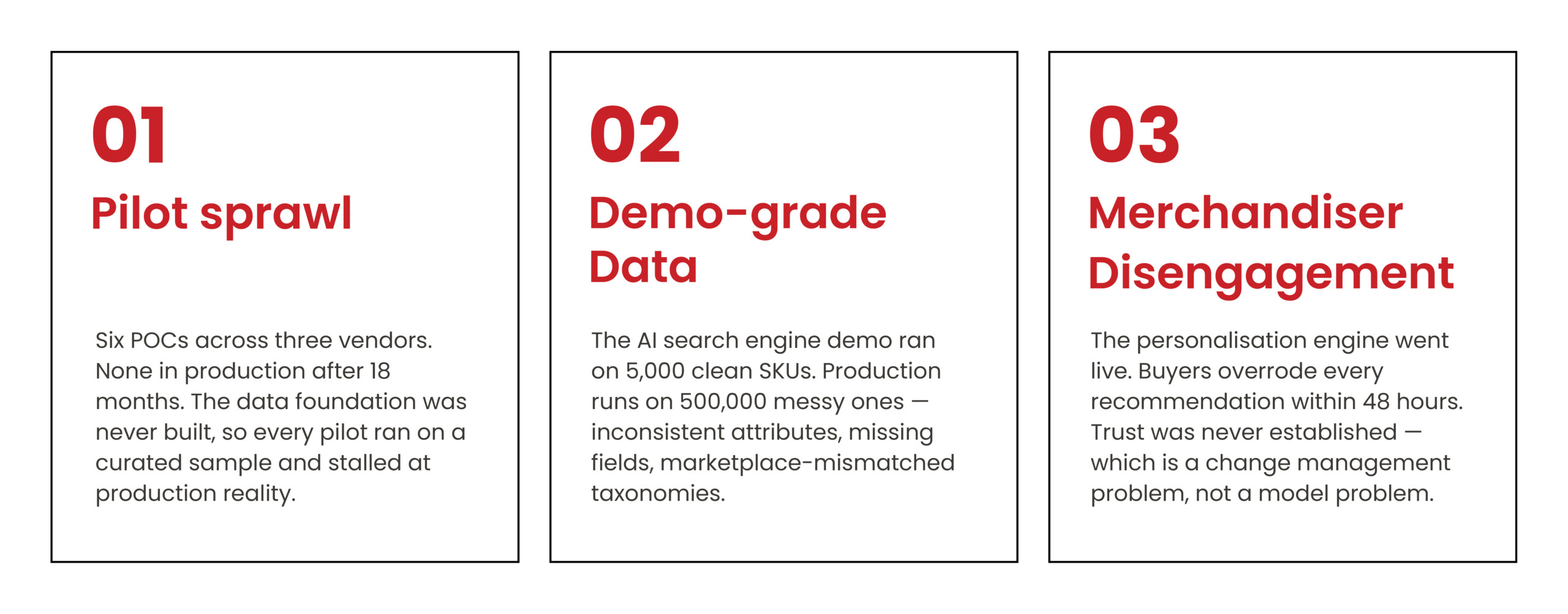
A fourth pattern has emerged recently: retailers adopting AI tools without foundational data readiness. They deploy AI for product descriptions before their catalog attributes are consistent. They install an AI recommendation engine before their CDP has real-time identity resolution. The tools are excellent. The foundation is not there to support them.
The Four Domains Where AI Creates Real Commercial Value
AI transformation in retail does not happen everywhere at once. It compounds across four domains, each independently valuable and each making the others more powerful. The sequencing matters — and the catalog is always the foundation.
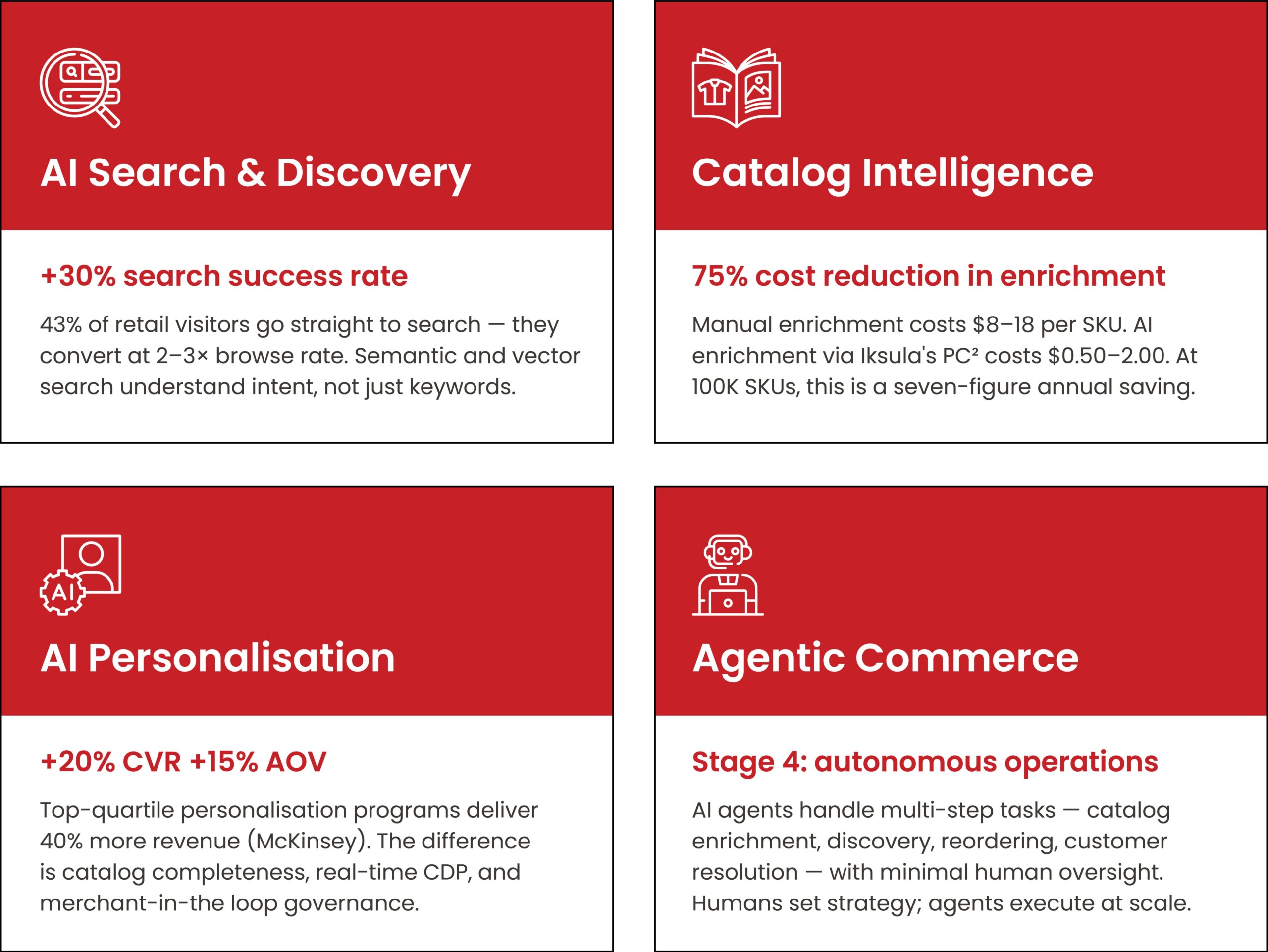
These four domains compound. Better catalog data improves search relevance. Better search generates stronger behavioural signals for personalisation. Better personalisation feeds richer intent data back into catalog prioritisation. Retailers who invest in the data layer first build a defensible moat that late movers cannot easily replicate.
The Prerequisite Nobody Talks About: Catalog Data Quality
The single highest-impact investment a retailer can make before deploying any AI system is not the AI system itself — it is the quality of the product data it will run on. Catalog data quality in AI deployments is the single most under-reported cause of failed programmes. We have seen it across every vertical: fashion, electronics, grocery, DIY, beauty, and luxury.
Here is the production evidence
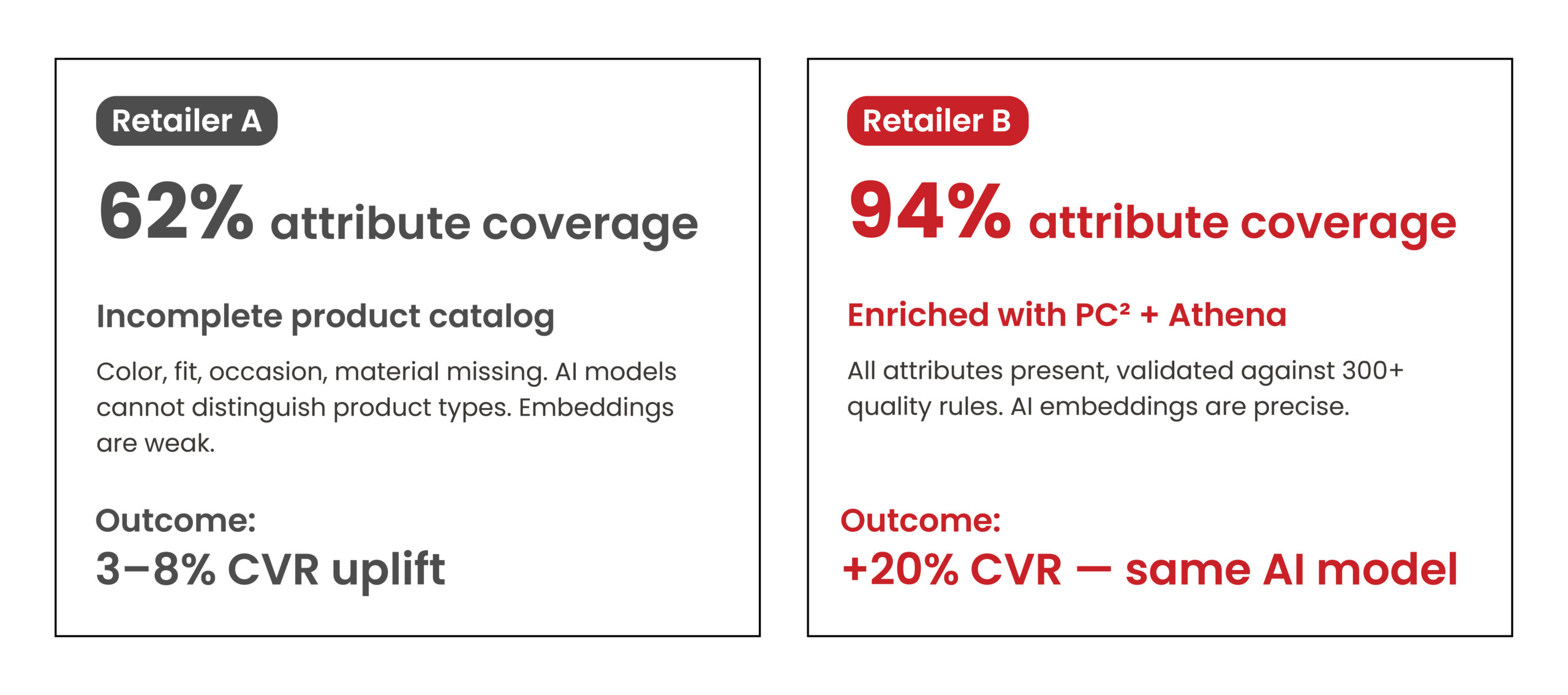
The same AI model. The same platform. A 17× difference in business outcome — attributable entirely to catalog data completeness.
This is why the right sequence for retail AI transformation is: catalog data → search → personalisation → agentic. Retailers who skip to step three will get modest returns, lose confidence in AI, and re-do the catalog work anyway — only later, under more pressure, with less budget.
The good news: catalog enrichment is no longer a 12-month waterfall project. With AI enrichment tools like Iksula’s PC² and Athena quality engine, a 100,000 SKU catalog can reach 92–95% attribute completeness in 28–35 days at $0.50–2.00 per SKU — versus $8–18 for manual enrichment.
AI Search, Personalisation, and the Connected Commerce Stack
AI personalisation is one of four domains driving AI transformation in retail — and it depends on getting the other three right first. AI-powered search is a pillar of any serious retail AI transformation strategy — but it only compounds when deployed alongside personalisation and catalog intelligence.
The connection works in both directions. AI search improves when it knows which products a customer personalises toward. AI personalisation improves when it receives intent signals from search behaviour. Both improve when the catalog underneath them is complete and consistently structured.
The Rise of Agentic Commerce: Optimising for AI Agents, Not Just Humans
The emerging frontier of retail AI transformation — and one of the most significant shifts in generative AI retail strategy — is one that most retailers are not yet thinking about strategically: AI agents shopping on behalf of consumers.
Google’s Universal Cart, ChatGPT’s shopping capabilities, Perplexity’s product discovery, and a growing ecosystem of AI copilots are increasingly completing purchases without the customer ever visiting a traditional storefront. A user asks their AI assistant to find and order a product. The agent searches, evaluates, and transacts — all without a single click on your website.
This shift has a profound implication: you now need to optimise not only for human shoppers, but for AI agents that shop on behalf of consumers.
What AI agents need to evaluate and recommend your products:
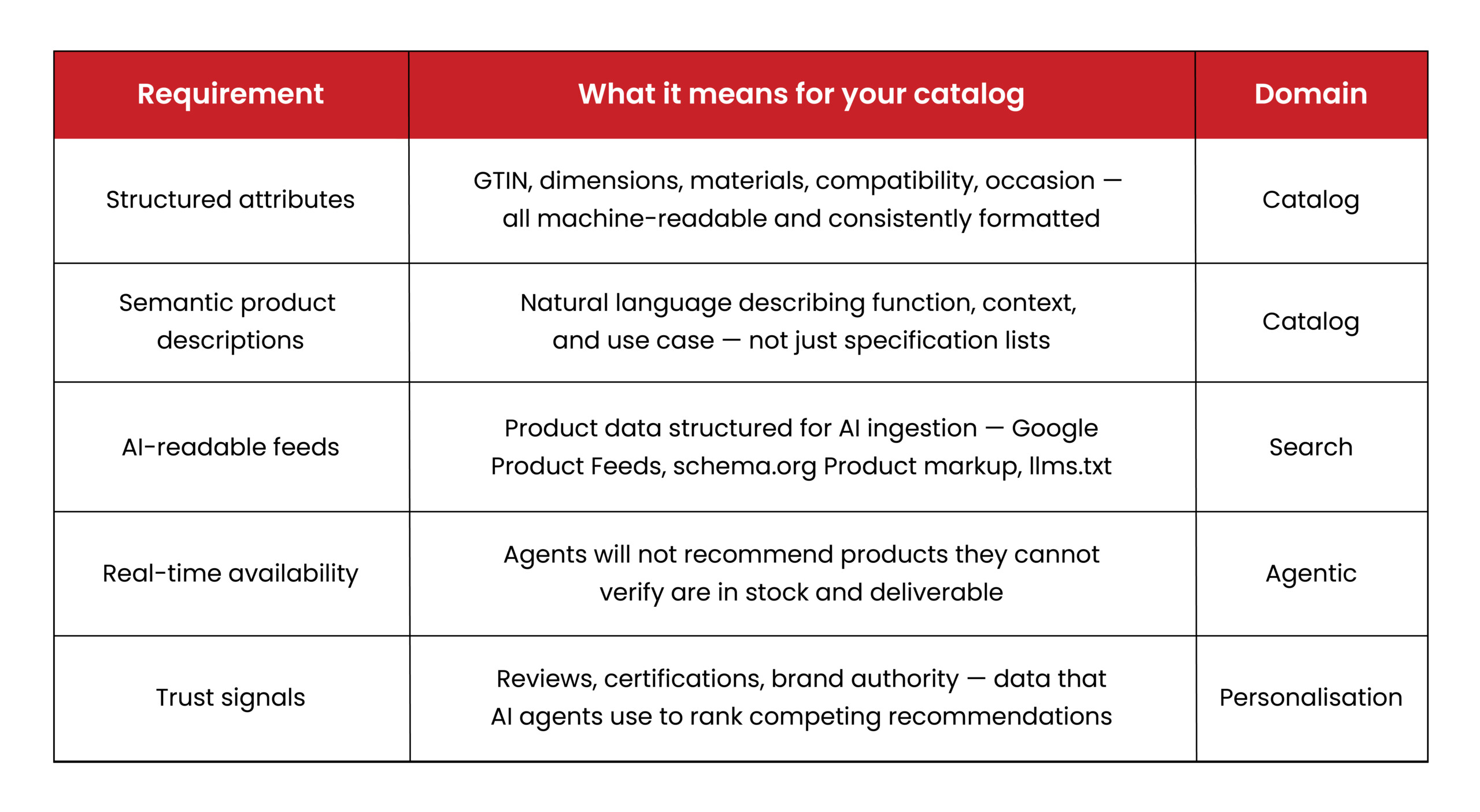
Retailers who build an AI-readable product catalog — with complete attributes, structured data, and semantic descriptions — are positioning themselves to win in both human and agentic commerce. Retailers who don’t will become invisible to AI-assisted shoppers, regardless of how strong their website experience is.
The Real Challenges in Retail AI Transformation
AI transformation in retail involves genuine technical and organisational complexity. The retailers who underestimate this tend to be the ones who stall at Stage 2. The ones who succeed go in with clear eyes.
Data readiness is the most common blocker
Legacy product data was built for human readers and keyword search — not for AI model training. Attribute schemas vary by category, supplier, and import date. Taxonomies were never designed for marketplace-native AI requirements. Fixing this is not a one-time project; it requires ongoing governance.
Legacy system integration takes longer than expected
Most enterprise retailers run PIM systems, OMS platforms, CDPs, and commerce engines that were not designed to share data in real time. Integration layers are the hidden cost in every AI transformation programme — and the most common cause of timeline overruns.
Organisational change is harder than technical change
Merchandisers who have spent their careers making decisions by instinct do not trust an algorithm they cannot interrogate. The merchant-in-the-loop operating model — where humans set constraints and AI executes within them — is the governance architecture that resolves this tension.
Privacy and compliance are non-negotiable constraints
Real-time personalisation requires customer data. Customer data is subject to GDPR, CCPA, and a growing patchwork of regional regulation. Compliance architecture must be built into the data foundation from day one.
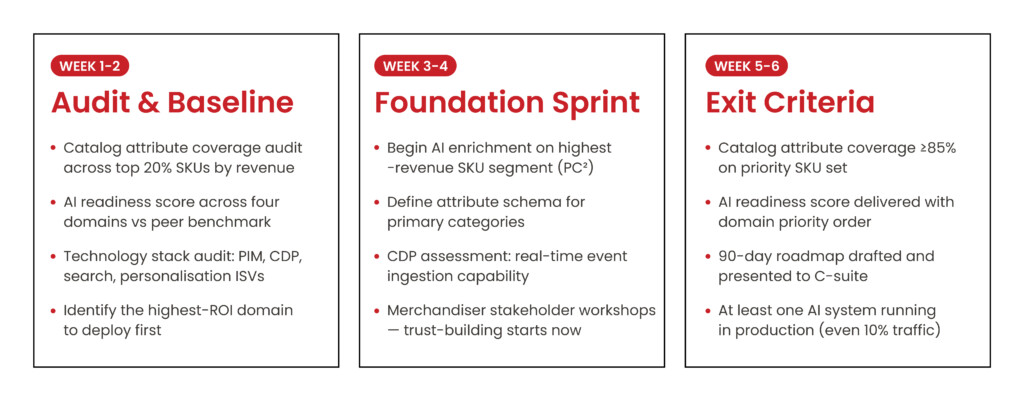
Where to Start: The first 30 Days of AI Transformation
If you are asking how to implement AI in retail without repeating the mistakes of the 85%, the answer is sequencing. The journey from AI pilot to production is the critical crossing that most retailers fail to complete. Here is what the first 30 days should look like.

Frequently Asked Questions: AI Personalization for E-Commerce
Each answer is written to be citation-complete — usable by AI assistants, voice search, and featured snippet without surrounding context. Drawn from Iksula’s production deployments across 400+ AI programs and 18+ years of e-commerce operations.
|
AI transformation in retail is the shift from isolated AI pilots to governed, production-grade intelligence embedded across search, personalisation, catalog, and supply chain — replacing manual workflows with systems that learn, adapt, and compound value over time. It is not a chatbot, not a single ISV platform, and not a consulting report. It is an operating model change: the systematic replacement of human judgment-at-scale with machine intelligence-at-scale, while keeping merchants, buyers, and operators in the loop on every decision that requires domain expertise, brand voice, or customer trust. |
|
85% of retail AI programmes stall before reaching production scale. The three root causes are: pilot sprawl (multiple POCs across vendors, none in production, because the data foundation was never built); demo-grade data (the AI was tested on 5,000 clean SKUs but must run on 500,000 messy production ones); and merchandiser disengagement (AI recommendations go live but buyers override every decision within days because trust was never established). A fourth emerging cause is adopting AI tools without foundational data readiness. |
|
Iksula production benchmarks across enterprise retail deployments: 75% reduction in catalog enrichment costs (from $8–18/SKU manual to $0.50–2.00 via AI); +20–30% conversion rate uplift from AI personalisation; +30% improvement in search success rates; 60% reduction in photoshoot costs via AI visual intelligence; 40% catalog cost reduction via AI content generation. ROI compounds across domains — better catalog data improves search, which improves personalisation signal quality. McKinsey independently estimates the GenAI retail prize at $470B. |
|
Agentic commerce is where purpose-built AI agents handle multi-step commerce tasks — product discovery, catalog enrichment, reordering, and customer resolution — with minimal human intervention. Consumers are increasingly using AI assistants (ChatGPT, Google Gemini, Perplexity) to search for and complete purchases. Retailers now need to optimise not only for human shoppers, but for AI agents that shop on behalf of consumers. This requires structured, attribute-rich, AI-readable product data including GTINs, semantic descriptions, and real-time availability. |
|
How to implement AI in retail without repeating the 85% failure rate? Start with catalog data quality — because every downstream AI system (search, personalisation, agentic) depends on clean, structured, attribute-rich product data. The first 30 days should cover: a catalog attribute audit, an AI readiness score across four domains, and an AI enrichment sprint on the highest-revenue SKU segment. Retailers who invest in catalog AI first see compounding returns across all subsequent AI investments. |
Conclusion
AI transformation in retail succeeds when the data layer, the operating model, and the commercial teams work together. The retailers who succeed are not the ones with the biggest AI budget — they are the ones who sequence correctly, fix the catalog first, build merchant trust early, and treat AI as an operating model transformation rather than a technology procurement.
If you are evaluating where to start, book a 30-minute AI readiness review with Iksula’s retail practice. We will score your maturity across four domains and deliver a 90-day execution plan — no deck, no cost, no obligation.