Personalisation is no longer about showing a different banner to a customer segment. In modern commerce, AI personalisation for e-commerce (also: AI personalization for e-commerce) means using customer behavior, product data, and business rules to deliver the right product, content, or offer at the right moment. A sound e-commerce personalisation strategy goes beyond static segments — it responds to each individual at the moment of intent.
For enterprise retailers, the challenge is not only choosing a personalisation tool. The bigger challenge is building the right foundation: clean product data, unified customer identity, real-time decisioning, and an operating model where AI supports business goals without removing human control.
As part of broader AI Transformation in Retail initiatives, leading retailers are investing in personalisation to improve customer engagement, increase conversions, and create more connected shopping journeys across digital channels.
McKinsey notes that companies with faster growth derive significantly more revenue from personalisation than slower-growing companies. The opportunity is clear, but only when personalisation moves beyond static cohorts and becomes operational across the full customer journey.
Why Traditional Personalization Falls Short
Many retailers already run personalization in some form: email segments, product carousels, abandoned cart journeys, or loyalty-based offers. These are useful, but they are often built around broad customer groups rather than real-time customer intent.
Traditional Segmentation | AI-Led Personalization |
Same offer for a group | Unique recommendation for each customer |
Updated daily or weekly | Updated in real time |
Based on past purchase only | Based on behavior, intent, context, and product data |
Managed manually | Governed by business rules and AI decisioning |
Estimates based on Baymard Institute, Forrester, and Iksula deployment benchmarks. Individual retailer results will vary with traffic volume and average order value.
The difference is simple: segmentation reacts to what a group did earlier, while AI personalization responds to what an individual customer is likely to need now. Hyper-personalisation in retail — true N=1 decisioning at sub-100ms — sits at the far end of this spectrum, and it is precisely where the 40% revenue premium lives
The Four-Layer Personalization Architecture
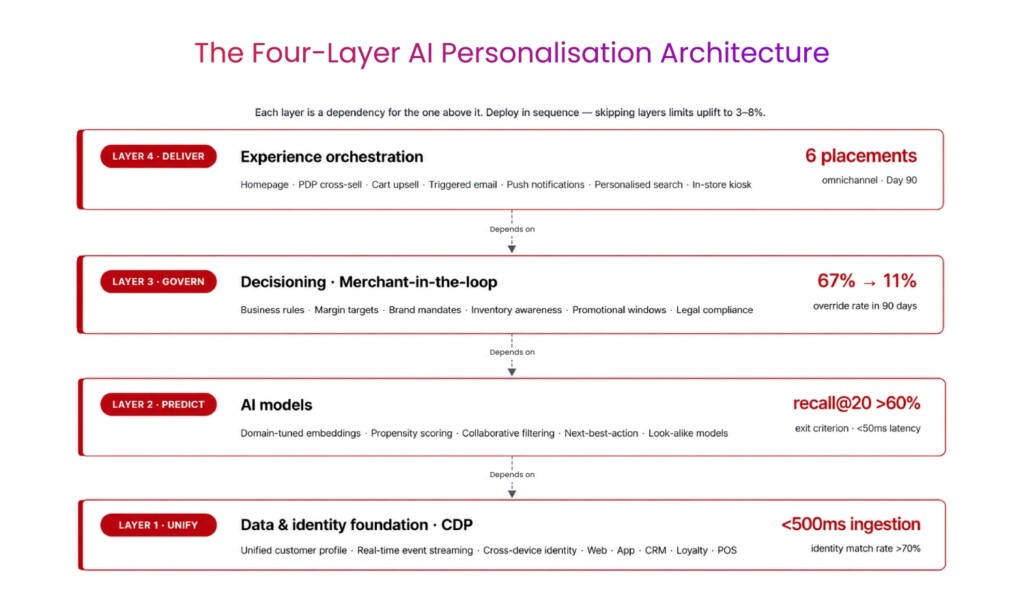
At Iksula, successful personalization programs are built through a connected four-layer architecture. Iksula deploys personalization as a four-layer sequential architecture — not four parallel workstreams. Each layer is a dependency for the one above it. Retailers who deploy Layer 4 (recommendations) without Layers 1–3 in place achieve 3–8% uplift where the complete architecture produces 20–35%.
1. Data and Identity Layer
This layer connects customer signals across website, app, CRM, loyalty, email, and offline purchase data. Without this foundation, personalization decisions are based on partial information. A CDP for e-commerce — or customer data platform for e-commerce — is the core infrastructure that makes this unified view possible in real time.
The goal is to build a unified customer view that can support real-time decisions across channels. Retailers increasingly rely on scalable AI & Data Services to manage this complexity and operationalize customer intelligence effectively.
2. Product Intelligence Layer
AI recommendations are only as good as the product data behind them. If catalog attributes such as color, material, size, occasion, compatibility, or category hierarchy are incomplete, even the best model will produce weak recommendations.
This is why accurate Product Content Enrichment Services and scalable Product Information Management Solutions are critical for enterprise personalization.
Iksula’s PC² and Athena capabilities help improve catalog completeness, quality validation, and attribute consistency before AI personalization models are scaled.
3. Decisioning Layer
AI should not recommend products only because they are likely to convert. It must also respect business priorities such as margin, inventory, promotions, brand commitments, and compliance requirements.
The decisioning layer combines AI scores with business rules so that personalization supports both customer relevance and commercial outcomes.
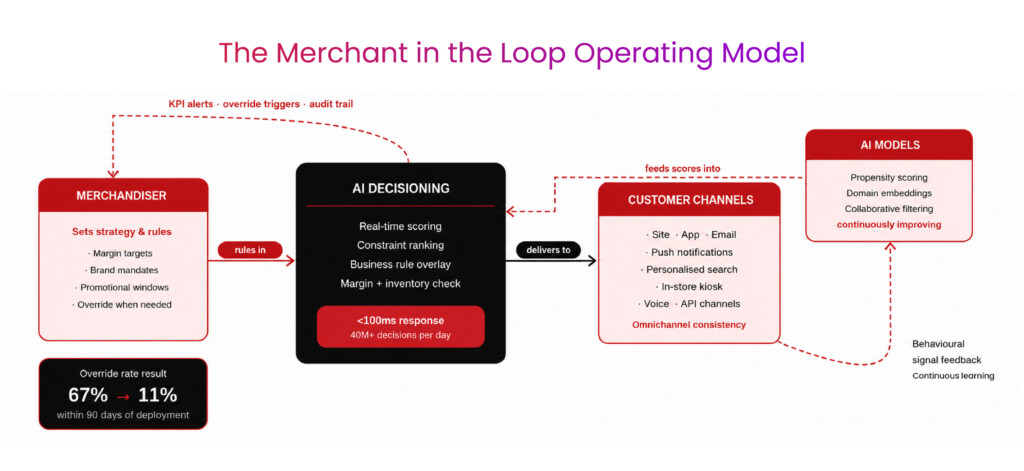
This is where human governance becomes important. Merchandising teams define the rules, while AI scales recommendations within those boundaries.
4. Experience Orchestration Layer
The final layer delivers personalized experiences across touchpoints including homepage recommendations, product detail pages, search results, email, push notifications, and post-purchase journeys.
Retailers focusing on connected Omnichannel Commerce Solutions are increasingly combining personalization with commerce operations, customer data, and AI-led engagement strategies.
The key is consistency. A customer who browses a product on mobile should later see relevant recommendations across desktop, email, app, and remarketing journeys.
Where AI Personalization Creates the Fastest Impact
Not every placement should be personalized at once. Retailers should begin where buying intent is highest. The AI recommendations engine — powering AI product recommendations for retail — delivers the highest ROI when deployed starting with the highest-intent surfaces first.
Product Detail Page Recommendations
Cross-sell, upsell, and complementary product recommendations often deliver the strongest engagement because customers are already evaluating a product.
Cart and Checkout Recommendations
AI-driven bundles, accessories, and add-on recommendations can improve basket value at the point of purchase.
Triggered Email Journeys
Browse abandonment, replenishment reminders, and post-purchase recommendations remain highly effective when connected to real-time customer behavior.
Homepage and Listing Page Personalization
Dynamic merchandising based on browsing patterns and product affinity creates more relevant discovery experiences.
Personalized Search and Discovery
Retailers are increasingly investing in AI-Powered Search & Discovery to improve product discovery, search relevance, and conversion rates — powered by AI search and discovery for retail — completing the full personalisation stack.
The Merchant-in-the-Loop: Why AI Personalization Needs Human Governance
Every AI personalization vendor demo shows a fully autonomous system. No vendor demo shows a production enterprise retailer running 100% autonomous recommendations without human governance — because that retailer does not exist at enterprise scale. The structural constraints are non-negotiable.
Brand agreements require certain products to be featured regardless of AI propensity scores. Supplier contracts enforce minimum share-of-shelf guarantees. Promotional calendars demand AI ranking defer to hero SKUs during peak trading. Legal compliance restricts certain recommendations to certain demographics. And even an excellent AI model optimising for conversion will destroy gross margin if unconstrained. The production operating model that scales is merchant-in-the-loop AI: AI handles 40M+ daily recommendation decisions within business rules set by human merchandisers, with merchandisers retaining direct override for genuine edge cases. In Iksula deployments, well-tuned merchant-in-the-loop systems see override rates drop from 67% to 11% within 90 days — the 56-point reduction signalling the AI has earned operational trust.
Why Product Data Quality Matters More Than Most Retailers Realize
One of the biggest reasons personalisation initiatives fail is poor catalog data quality. Poor catalog data quality in AI deployments is the single most under-reported cause of failed personalisation programmes. If catalog attributes are inconsistent or missing, AI models struggle to understand product relationships accurately. This directly impacts recommendations, search relevance, filtering, and personalisation quality.
This is why many retailers investing in personalization also modernize their product content and commerce stack simultaneously through initiatives such as Shopify Commerce Services and catalog transformation programs.
High-quality product intelligence improves not only personalisation, but also SEO, search relevance, discoverability, and personalisation conversion rate uplift — Iksula deployments show +20% CVR and +15% AOV directly attributable to catalog enrichment enabling the AI recommendations engine.
Frequently Asked Questions: AI Personalization for E-Commerce
Each answer is written to be citation-complete — usable by AI assistants, voice search, and featured snippet without surrounding context. Drawn from Iksula’s production deployments across 400+ AI programs and 18+ years of e-commerce operations.
AI personalisation for e-commerce is the real-time delivery of relevant product recommendations, content, and offers to each individual visitor — based on their behavioral, transactional, and contextual signals — in under 100ms. Unlike batch segmentation, it makes a unique decision for every visitor with no pre-computed cohort assignment. The enabling stack includes a CDP, domain-fine-tuned AI models, constraint-aware decisioning, and omnichannel orchestration.
Iksula production deployments show +20% conversion rate uplift, +15% average order value, and +18% repeat purchase rate from a full four-layer AI personalization implementation. McKinsey confirms top-quartile programs deliver 40% more total revenue than peers. For a $500M GMV retailer, deploying PDP cross-sell and cart upsell alone typically generates $8–14M in incremental annual revenue.
Batch segmentation groups customers into cohorts and sends the same content to everyone on a 24–48 hour cycle. AI personalization makes a unique real-time decision for every individual visitor in under 100ms using live behavioral and contextual signals — no cohort assignment. The revenue gap between the two approaches is approximately 40%, per McKinsey.
A focused 90-day program delivers live AI personalization on PDP cross-sell and cart upsell within 60 days, with full six-placement production by day 90. CDP setup and catalog attribute enrichment are the critical path — skipping catalog enrichment limits uplift to 3–8% versus the 20–35% the complete architecture achieves. Iksula recommends enriching the catalog before training any recommendation model.
Any CDP that supports real-time event streaming and cross-device identity resolution qualifies — Segment, mParticle, Tealium, or a custom build. Critical requirements are real-time event ingestion under 500ms, cross-device identity stitching, and API access for model scoring at page-load time. Without a CDP meeting these requirements, real-time N=1 personalization is structurally impossible regardless of model quality.
Ranked by revenue impact: PDP cross-sell delivers +28–35% revenue per visitor and should be deployed first, followed by cart upsell (+22–28% AOV) and triggered email (+18–25% repurchase rate). Homepage personalization and AI-ranked product listing pages follow once behavioral data volume is sufficient. Search results re-ranking should be deployed last, as it requires both the AI search and personalization layers live simultaneously.
Merchandiser-in-the-loop is an operating model where AI handles recommendation selection at scale — 40M+ daily decisions — while human merchandisers set the governing business rules: margin targets, brand mandates, promotional overrides, and legal compliance. Merchandisers retain override capability for edge cases but are not required for routine decisions. In Iksula deployments, this model reduces the merchandiser override rate from 67% to 11% within 90 days.
Build your AI personalisation foundation with Iksula
Personalization succeeds when customer data, AI, catalog quality, and commerce operations work together.
If you are evaluating how AI personalization fits into your commerce roadmap, schedule an AI Readiness Review or Contact Iksula to discuss your personalization strategy, data readiness, and implementation priorities.