Skip to content Skip to footer
A balance scale in a public square, weighing innovation against risk

AI Governance and Risk Management

Governance is not overhead. It is how AI becomes safe to scale. We build the controls, evidence, and operating rhythm your models need to run inside your risk appetite.

Talk to our governance team

The model works. The unmanaged risk is the hard part.

A proof of concept shows what a model can do. Production shows what can go wrong. Governance closes that gap before the gap becomes a finding.

data management 1

AI inventory and model registry

Know every model in the estate

One register for models, data, owners, and status.

data governance 2

Risk assessment and classification

Class risk before it compounds

Score use cases against privacy, fairness, safety, and operational impact.
Layer 1 20

Policy and control mapping

Make rules easy to prove

Map policies to controls that teams can follow and auditors can see.
real time insight 1

Monitoring and drift detection

Catch drift before it becomes damage

Track model performance, data shifts, and guardrail violations in production.
Enterprise Integration 1

Vendor and third-party AI governance

Extend control to third-party AI

Assess vendor models and tooling under the same risk standard.
AI Driven Alerts Recommendations 1

Incident response and escalation

Respond when a control breaks

Document containment, investigation, and remediation without hunting for the source.
data integration 1

Data governance and lineage

Know the data behind every decision

Trace data from source to model output with clear ownership.
data quality 1

Audit and reporting readiness

Turn governance into evidence

Produce audit trails, risk registers, and board reports from one source.

Two questions set the risk class

We start with two questions before any tool is selected: What changes if this model is wrong? Who can see the output? The answers set the classification and the controls that apply.

  • What data flows into the model
  • Who can change the prompt or the threshold
  • Where the decision lands in a human process
  • What the blast radius is for a wrong output
  • How often the model or its inputs change

Pipeline or decision point

A risk register is not a governance program. We map controls to the place where the model meets a business decision. That shows which controls matter and which are theatre.

  • Input validation and data checks
  • Human approval thresholds
  • Logging and traceability
  • Fallback paths and overrides
  • Ownership for every control

Controls that scale with risk class

A low-risk summarizer and a high-risk credit decision should not carry the same controls. We define control tiers that rise as the risk class rises.

  • Tier 1: logging and light review
  • Tier 2: staged approval and monitoring
  • Tier 3: full validation, audit, and human override
  • Control libraries mapped to each tier
  • Rebaselining when risk changes

Nothing leaves unmapped

Every data flow, model call, and output is mapped. If it touches a system, it appears in the register. Nothing stays as tribal knowledge.

  • Source systems and data owners
  • Model endpoints and APIs
  • Output destinations and consumers
  • Access and change logs
  • Residual risk notes

Three gates, no exceptions

Every model passes through three gates before production: risk classification, control coverage, and sign-off. No exceptions for pace.

  • Gate 1: risk class and owner
  • Gate 2: control set mapped and tested
  • Gate 3: accountable sign-off with evidence
  • Gate review before any model ships
  • Gate evidence retained for audit

Your rules become the test

Your policies turn into test cases. If a control can't be tested, it isn't a control. We write the test first.

  • Policy line to test case
  • Pass/fail criteria written before go-live
  • Automated checks where possible
  • Human review for judgement-heavy controls
  • Evidence captured for every test run

A change in use means a new classification

When a model moves into a higher-stakes decision, its risk class changes. New controls apply before the change ships.

  • New data source triggers reclassification
  • New decision owner triggers reclassification
  • New customer segment triggers reclassification
  • New regulation triggers reclassification
  • Now, not after the next audit

Where this runs

Governance runs where your models run: on your systems, under your access policies, inside your environment. We bring the operating rhythm, not a separate tool that requires export.

Talk to our governance team
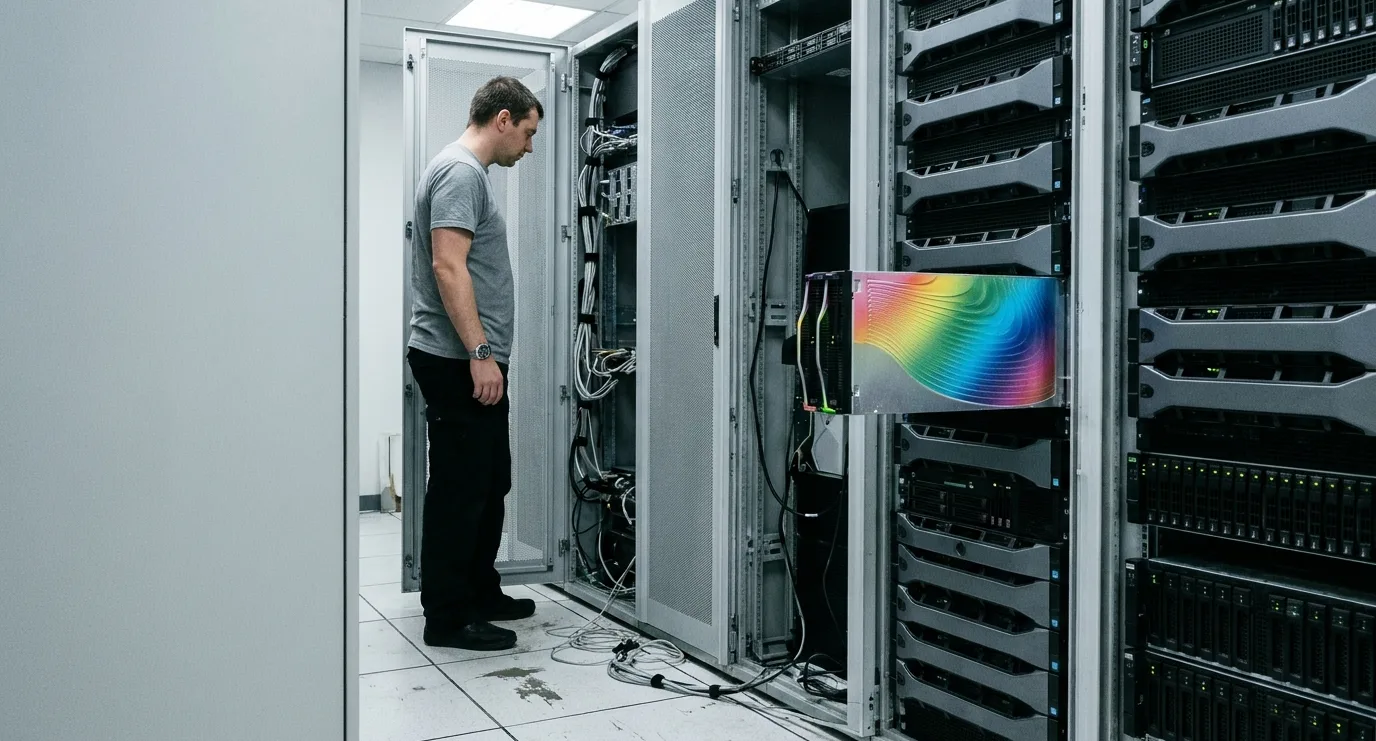

An engineer at the server rack where the governed AI workload runs
Mapping AI models in use during week one Week one: current state and risk appetite

Start with what is already live

We inventory models in use, including shadow AI. We map data flows and decision points. We agree on risk appetite before we design controls.

Designing AI governance controls Weeks two to three: control design

Design controls that fit how you work

We turn policies into controls and test cases. We assign owners and define thresholds. We keep the operating burden low enough that teams will actually follow it.

A balance scale in a public square, weighing innovation against risk Weeks four to six: pilot and audit trail

Prove the controls before scaling

We run a pilot on one high-visibility use case. We produce the audit trail and review it with your risk or compliance team. We adjust the controls before rollout.

An engineer at the server rack where the governed AI workload runs Steady state: when something goes wrong

Built for the day a control breaks

When an incident happens, we already know who owns it, what data is affected, and which control failed. We contain, investigate, and report without starting from scratch. Then we update the tests so the same break does not happen again.

Frequently asked questions

Short answers to the questions we hear most.

What can you realistically govern in six to twelve weeks?
In six weeks you can have an inventory of models in use, a risk classification, and a control set for the highest-risk use case. In twelve weeks you can add monitoring, an audit trail, and a repeatable process for new models. We start with what is already live, not a green-field framework.
Do you govern models, tools, or agents?
All three. We govern the decision point, not just the model file. That includes predictive models, generative tools, retrieval pipelines, and agentic workflows. The control set changes with the risk class.
Which frameworks do you align with?
We map to the NIST AI Risk Management Framework and ISO 42001 where they apply. We also track jurisdiction-specific obligations such as the EU AI Act. The output is your control set, not a generic compliance certificate.
Will this work with our existing ERP and data platforms?
We design governance to run on your systems. We can work with the platforms you already use, including ERP, data warehouses, and model registries. We do not require you to move data into a separate governance tool.
Can our data stay inside our own environment?
Yes. We work inside your environment and under your access policies. Governance metadata, logs, and tests can all stay within your boundaries. We do not require external data transfer.
What happens once governance is live?
We run the operating rhythm: risk review meetings, control testing, drift monitoring, and incident response. We do not hand over a static document. The controls are tested and updated as models and uses change.
Can you govern something another vendor built?
Yes. We start with the system as it exists. We map its data flows, decision points, and existing controls. Then we close gaps and document what is missing. We do not need to rebuild it to govern it.
How do you decide the right level of control?
We classify each use case by what happens if it is wrong and who is exposed. The classification sets the control tier. Low-risk uses get lighter controls. High-risk uses get stricter testing, approval, and monitoring.

Last updated 25 Nov 2026 · Reviewed by DJ Basumatari

Connect with our experts

See clearly. Then change it. Talk to our governance team about your current AI risk posture. We will start with the problem, not a tool.

DJ Basumatari

DJ Basumatari

Chief Executive Officer

Abhishek Jain

Abhishek Jain

Director - Solutions & Innovation

Trending Topic

AI governance and risk: how teams move from policy to proof, and from proof to an operating rhythm.